
AIMA Ajuda
Helping immigrants understand where they stand before they enter the system.
A guided orientation tool integrated into AIMA’s official website, helping immigrants understand their likely legal framework, indicative documents, and next steps before any formal application begins.
Role
UX Research, Interaction Design, UI Design
Team
Margarida Marçal, Inês E., Ana C., Catarina N.
Timeline
Feb - Mar 2026
Tools
Figma, Miro, Adobe Illustrator
Type
Academic project, EDIT. Disruptive Digital School
CONTEXT
AIMA, in brief
AIMA is Portugal’s immigration authority, responsible for residency authorisations, visa renewals, asylum, and integration support. Since 2023, it has worked as a single point of contact for some of the most complex administrative processes a person can face: legal residency.
A system built around legal categories, not user situations
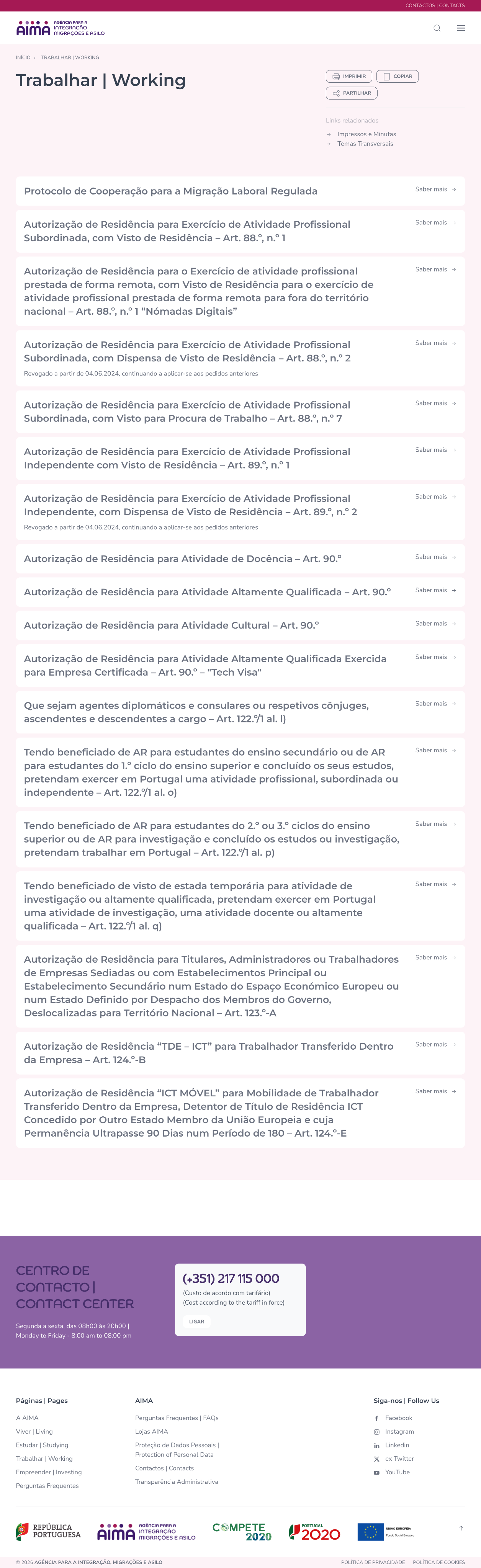
AIMA’s digital experience organises information around legal articles, not user situations. Users are expected to know which process applies to them before the system has helped them understand where they stand.This gap became the starting point for AIMA Ajuda.
RESEARCH FOUNDATION
Evidence from the places users were already asking for help
To understand where users were getting stuck, we combined public complaint data, community analysis, direct user research, and UX benchmarking.
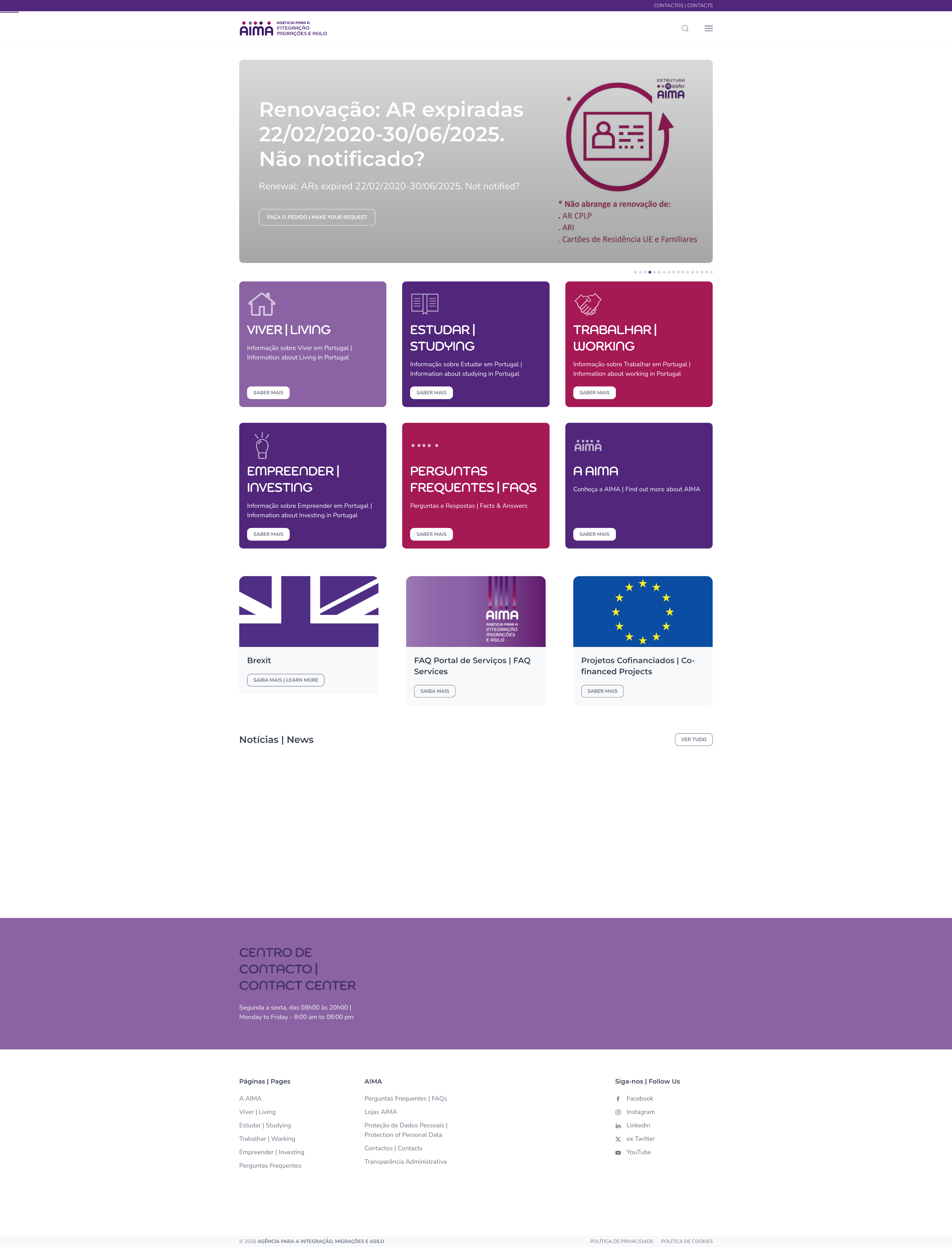
Because immigrants in active legal processes can be difficult to recruit through conventional methods, we looked at the places where uncertainty was already visible: Reddit threads, Facebook groups, immigrant forums, survey responses, and one exploratory focus group. We also reviewed the official AIMA website through a heuristic benchmark and compared it with international immigration platforms.
Evidence sources:
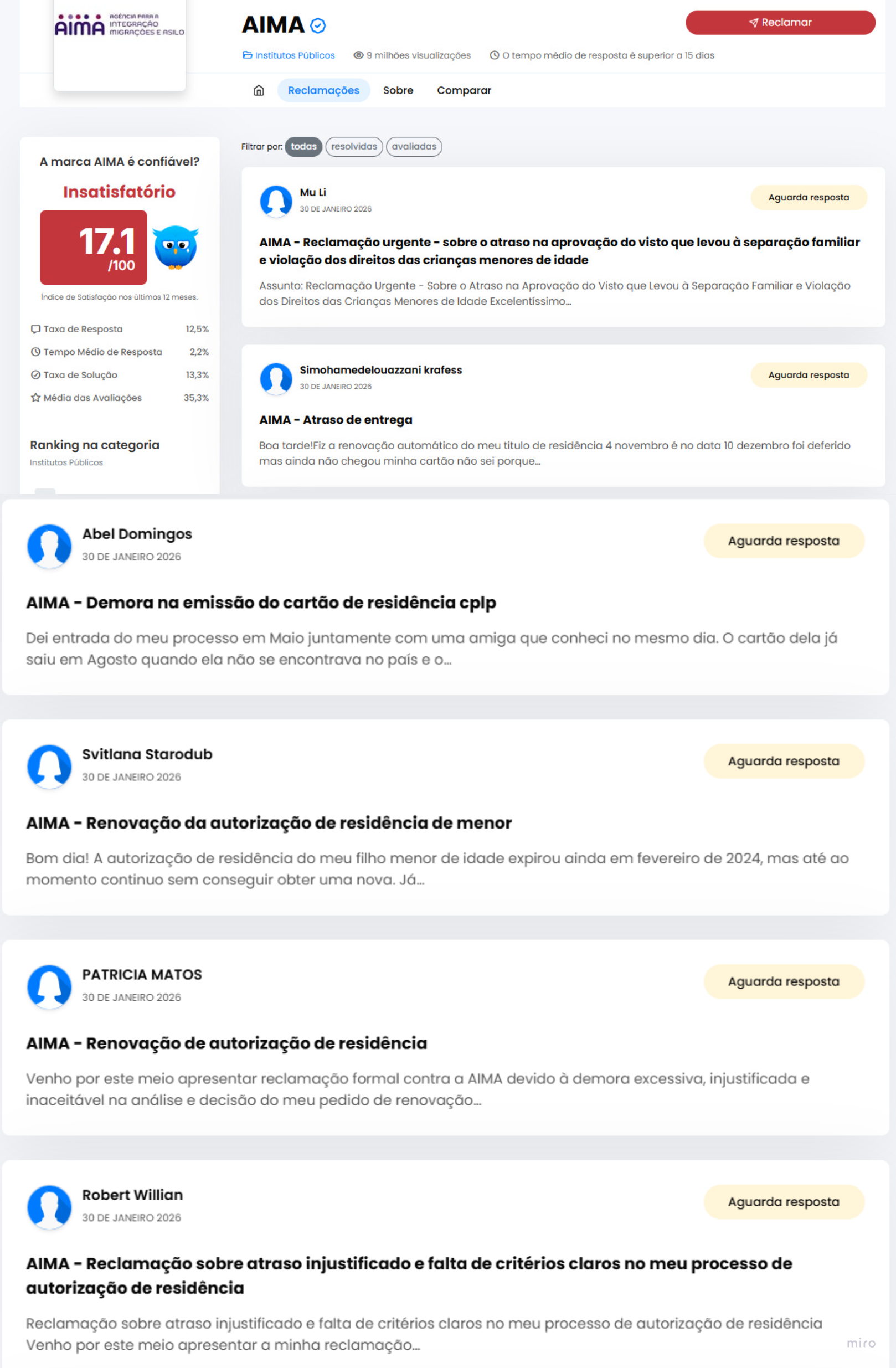
Portal da Queixa data
International benchmark
Survey (N=10)
Focus group (3 participants)
AIMA heuristic benchmark
Community analysis
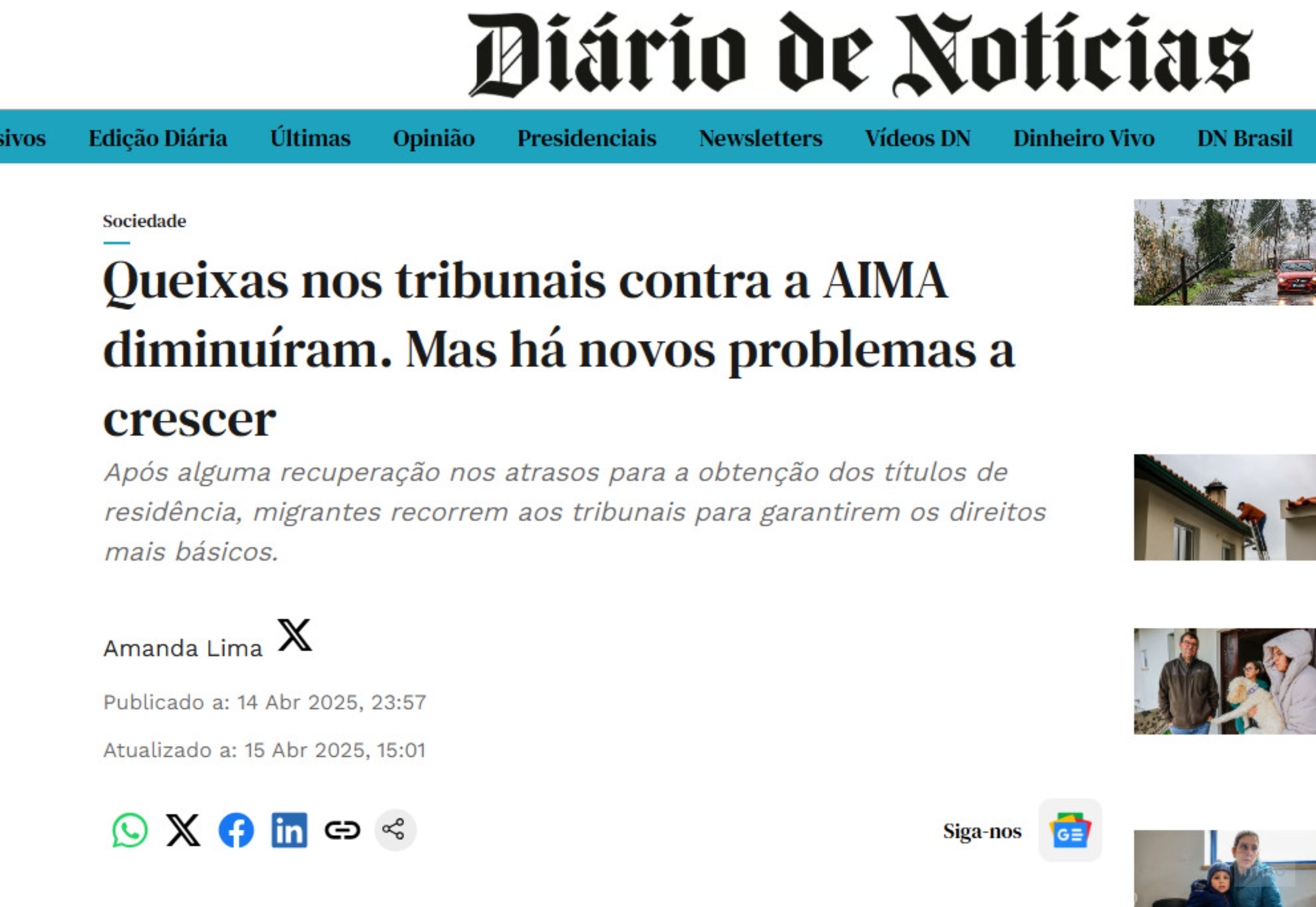
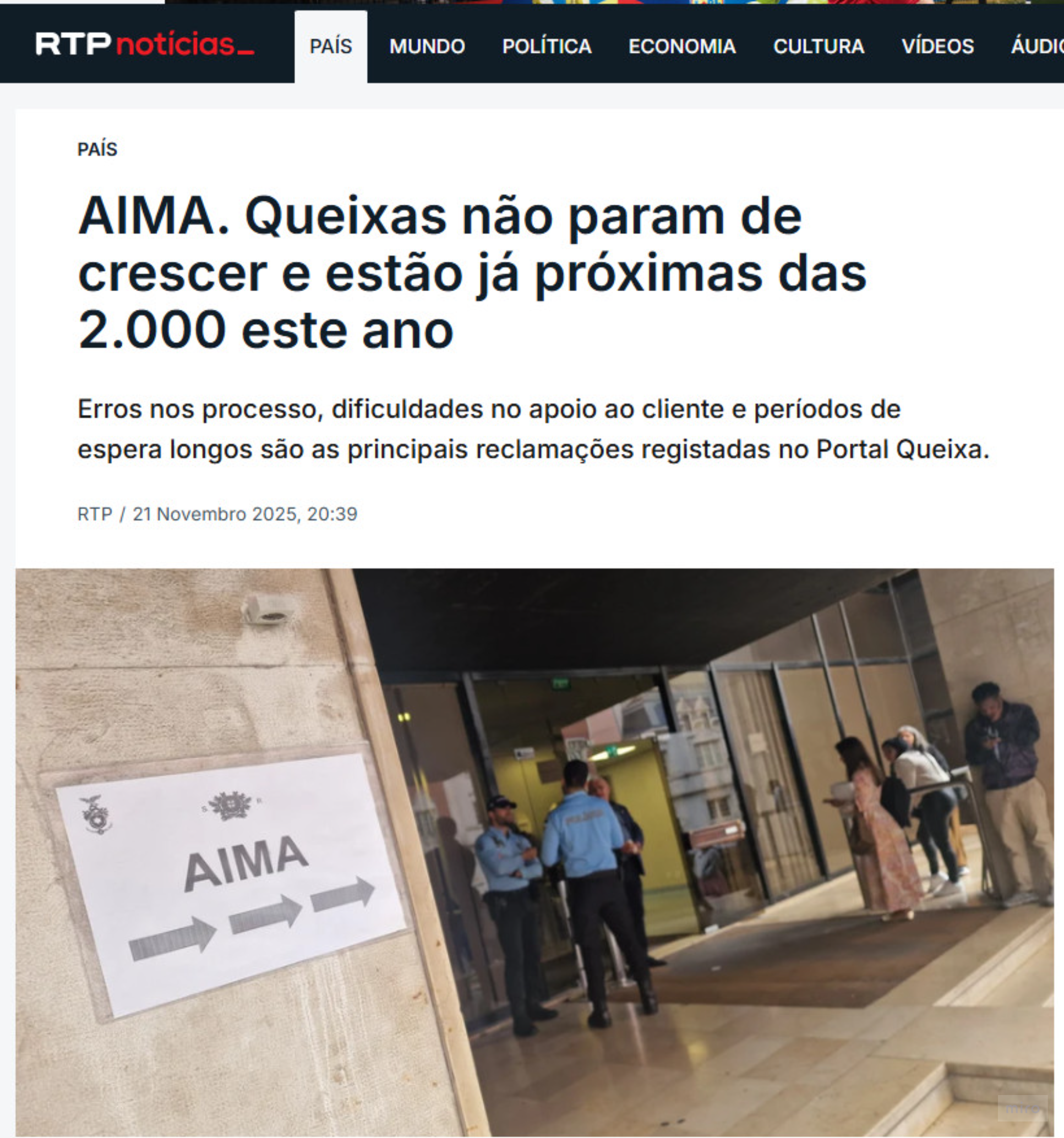
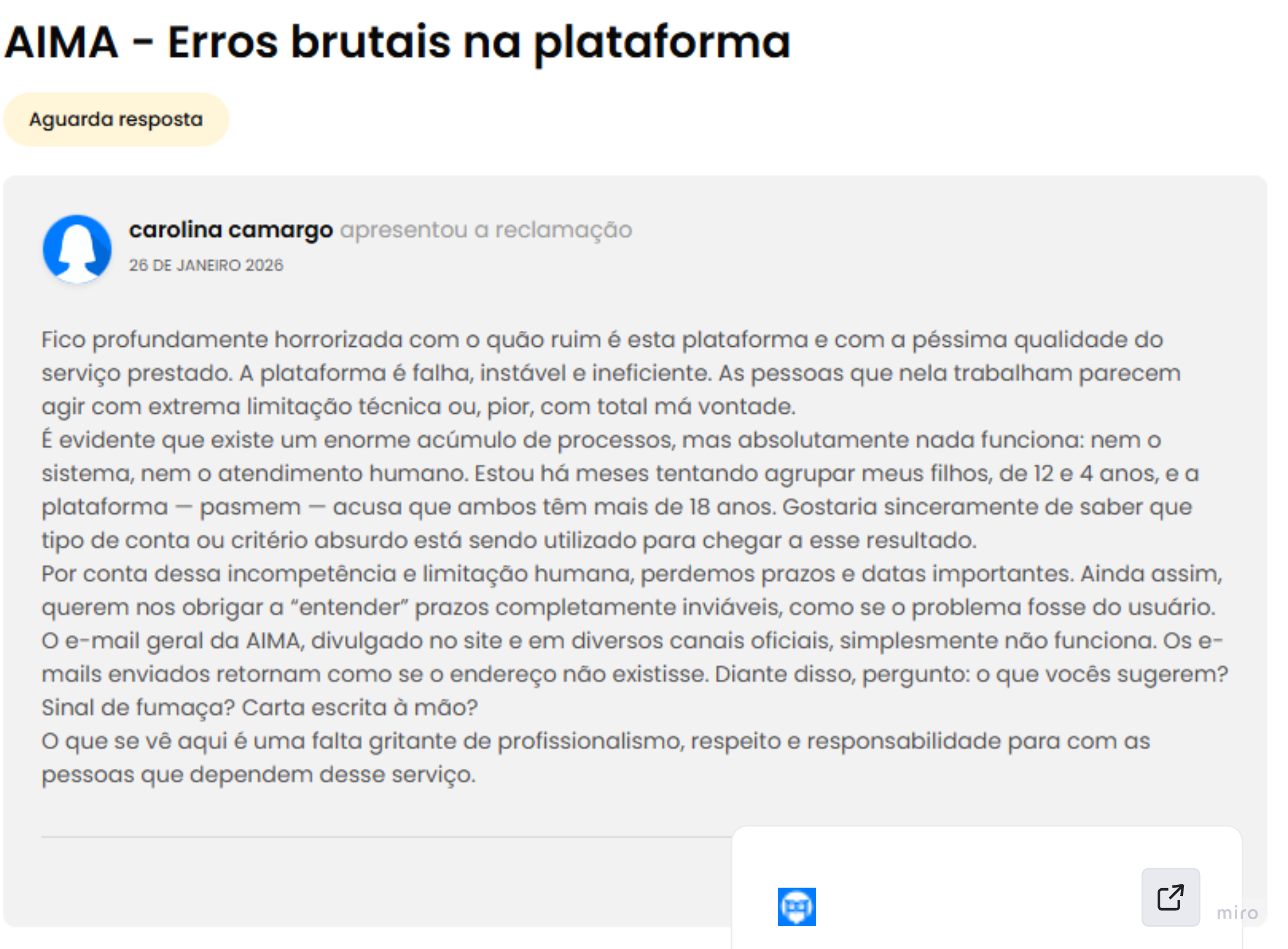
Public complaint data helped quantify the pressure on the system. The qualitative research helped explain what was happening before users reached those failure points.
Portal da Queixa analysis, accessed March 2026.


45%
communication failures
or no response
15%
document
submission errors
30%
delays in residence
card delivery
18%
overall
satisfaction rate
The numbers pointed to a system under pressure, but the research showed that many problems started earlier. Users were already lost before knowing which legal process applied to them, which documents mattered, or where to begin.
INSIGHTS
Five patterns shaped the solution
The research showed that users were not struggling because information was missing. They were struggling because the system expected them to understand which information applied to them before helping them make sense of their situation.
INSIGHT 1

The problem started before AIMA
Users were still trying to understand their own situation when the system already expected them to know which process applied to them.
INSIGHT 2

Information existed, but did not orient
Users could find content, but struggled to identify the right legal article, portal, documents, and order of steps.
INSIGHT 3
Legal language made mistakes feel risky
A misunderstood requirement could delay a residency process by months, affecting work, family stability, and legal status.
INSIGHT 4
Users relied on informal guidance
WhatsApp groups, Facebook communities, Reddit threads, TikTok videos, and informal advice became primary sources of orientation.
INSIGHT 5
Users wanted clarity, not automation
They did not want the system to decide for them. They wanted to understand which framework may apply, what documents matter, and what to expect next.
SYNTHESIS
Confusion had become part of the experience
The AIMA heuristic benchmark gave the research findings a structural frame. Cognitive load and deadline predictability were the two weakest criteria, both scoring 1 out of 5. The issue was not only that users felt confused. The interface repeatedly shifted responsibility onto them through ambiguous calls to action, dense legal text, hidden next steps, inconsistent interfaces, and weak feedback after key actions.
The opportunity was not to redesign the institution, simplify the law, or automate decisions. It was to add the missing layer between information and action.
A guided entry point.
USERS
Two very different users, one shared uncertainty
The research did not point to a single user archetype. It revealed two, and the distance between them matters.
Priya and Lucas sit at opposite ends of the spectrum: different languages, different levels of digital confidence, different devices, and different risk profiles. But neither of them could look at the AIMA platform and say with certainty: this is my process, and this is what I need to do.
What they reveal
One user struggles to access the system. The other struggles to trust its logic. But both reach the same point of uncertainty: the platform expects them to understand the process before it has helped them understand where they stand.
That became the design challenge: creating a guided starting point that could support both users without flattening their differences.
DESIGN CHALLENGE
AIMA’s digital experience was built for people who already know what they need. Our users don't yet.
PROBLEM STATEMENT
How might we help immigrants understand their legal standing in Portugal before they are asked to navigate a system that assumes they already know what they need?
GUIDING QUESTION
SOLUTION OVERVIEW
A guided entry point before formal action
AIMA Ajuda is a guided orientation tool designed to sit inside the official AIMA website, before any formal application begins.
Instead of asking users to read legislation and identify the right process on their own, it leads them through a short, structured orientation flow and returns a guided result they can use to prepare for their next interaction with AIMA.
STRUCTURED GUIDANCE AND AI USE
Where AI enters, and where it stops
The most important design decision in AIMA Ajuda was not visual. It was structural.
To build trust in a high-stakes public service, we separated structured guidance from AI use. The quiz works as a fixed, predictable flow, built around questions informed by relevant legislation and administrative requirements. It collects structured input, but it does not interpret, infer, or decide.
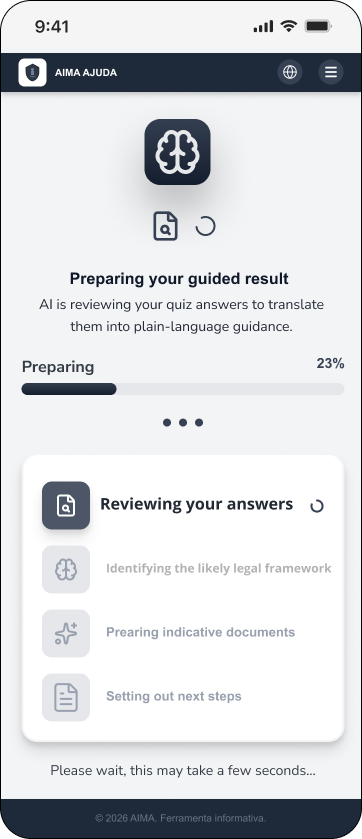
AI only enters after the quiz is complete. At that point, it helps translate the completed answer set into plain-language guidance, including a likely legal framework, why it may apply, the relevant legal reference, indicative documents, important notes, and next steps.
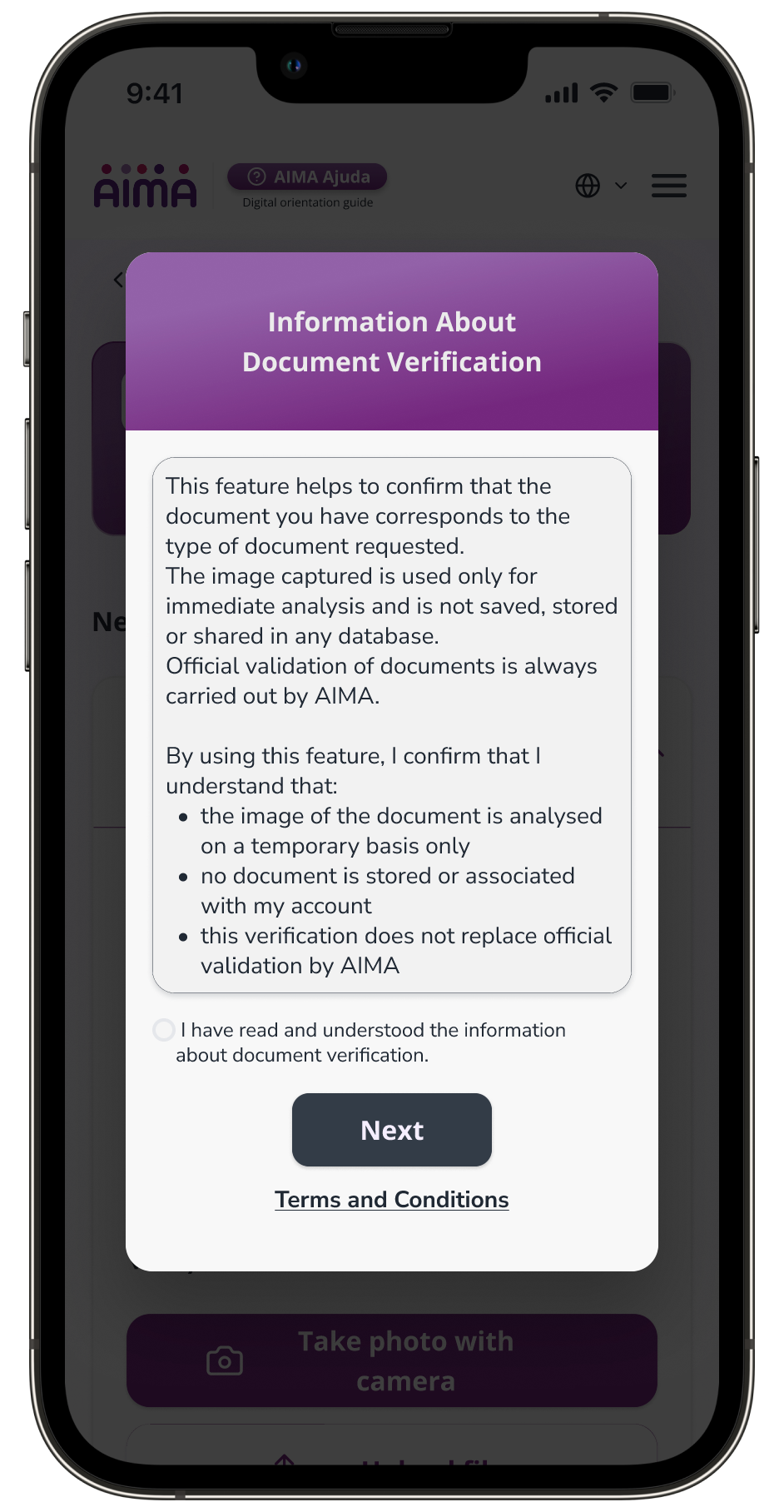
A second AI layer is available only if the user chooses to continue to the optional document check. Because this involves personal documents, it is optional and requires explicit acceptance of terms and conditions before any upload or analysis begins.
The system can check whether an uploaded document appears to match the expected type, whether key fields are present, whether the image is legible, and whether anything important seems to be missing. The result is returned as a preparation status: apparently adequate, potentially problematic, or clearly incorrect.
In every case, the interface reinforces that final validation remains exclusively with AIMA.
AI is used twice, but never as a legal decision-maker.
DESIGN PROCESS
From paper to product
The process started on paper. Three members of the team independently sketched different approaches to the main flow, exploring how the experience could guide users from uncertainty to preparation.
The full team then reviewed those early ideas together. Rather than selecting a single proposal, we carried forward the strongest parts of each: a clearer introduction before users were asked to act, a distinct orientation layer within the AIMA website, and a structured quiz-led flow with guided results and optional document check.
The process was not linear. Every iteration came back to the same question: what is the most critical moment for the user, and what is the simplest way to support it?
01 PAPER EXPLORATION
Three initial sketches explored different ways of guiding users through the main flow.
02 WHAT CARRIED FORWARD
The final flow was shaped by translating the strongest ideas from each early proposal into clearer moments of guidance.
What the sketches revealed
What it became

A clear starting point

Introductory wizard

A distinct orientation layer
AIMA Ajuda before formal action
A predictable progression
Quiz → guided results → optional document check


Guided orientation before formal action
03 DIGITAL STRUCTURE
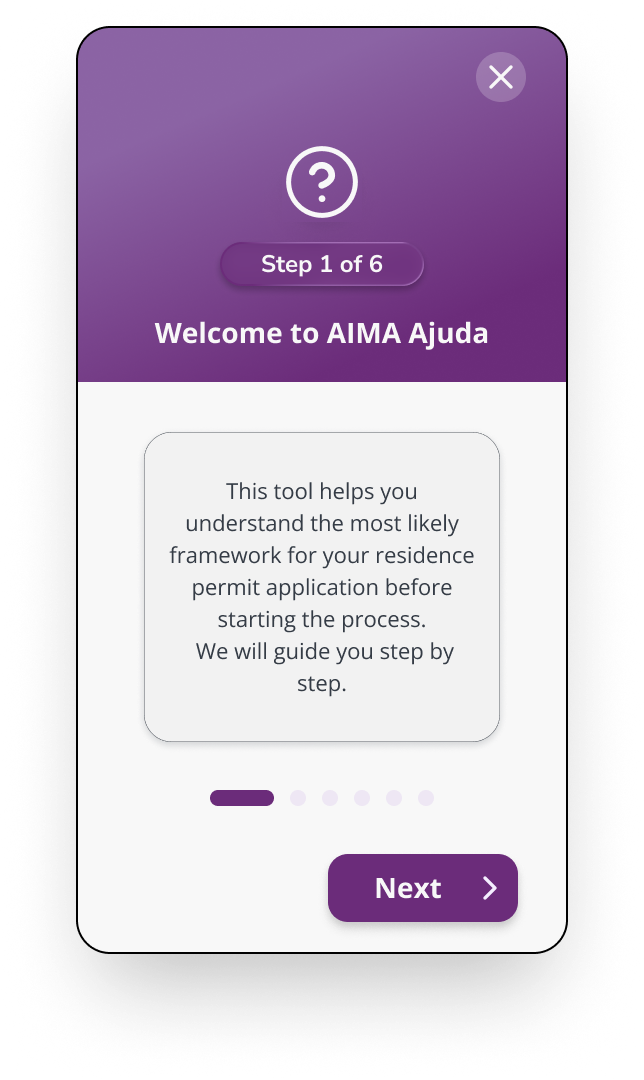
Representative screens from the mid-fi flow.
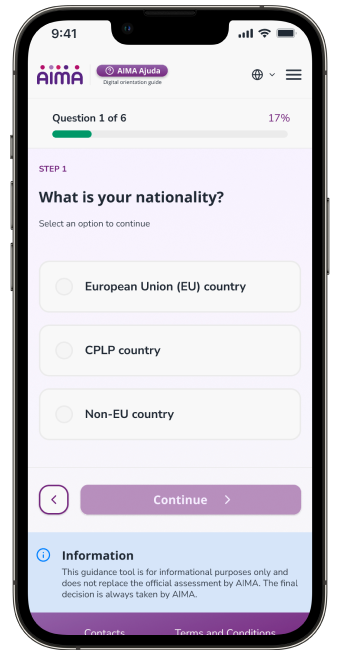
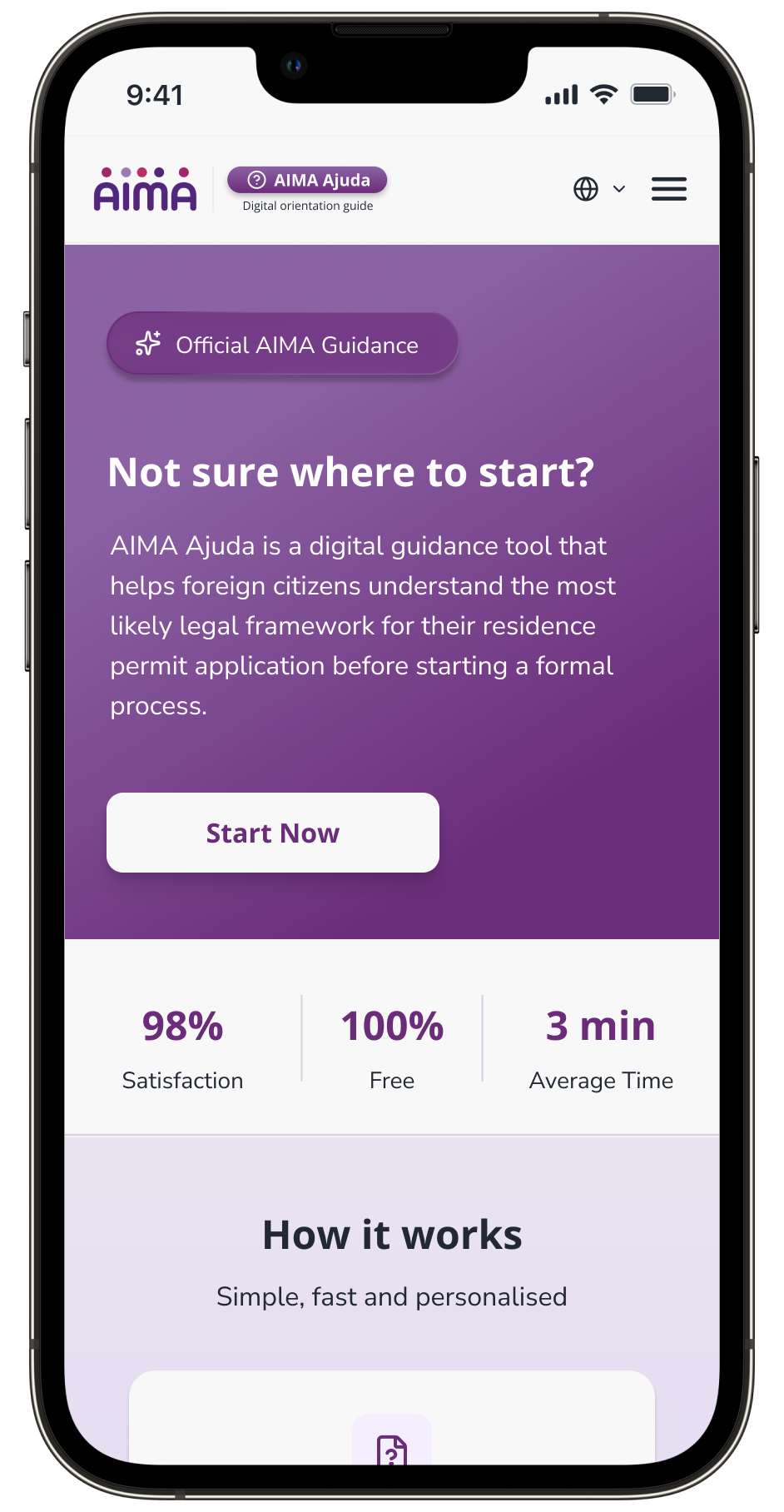
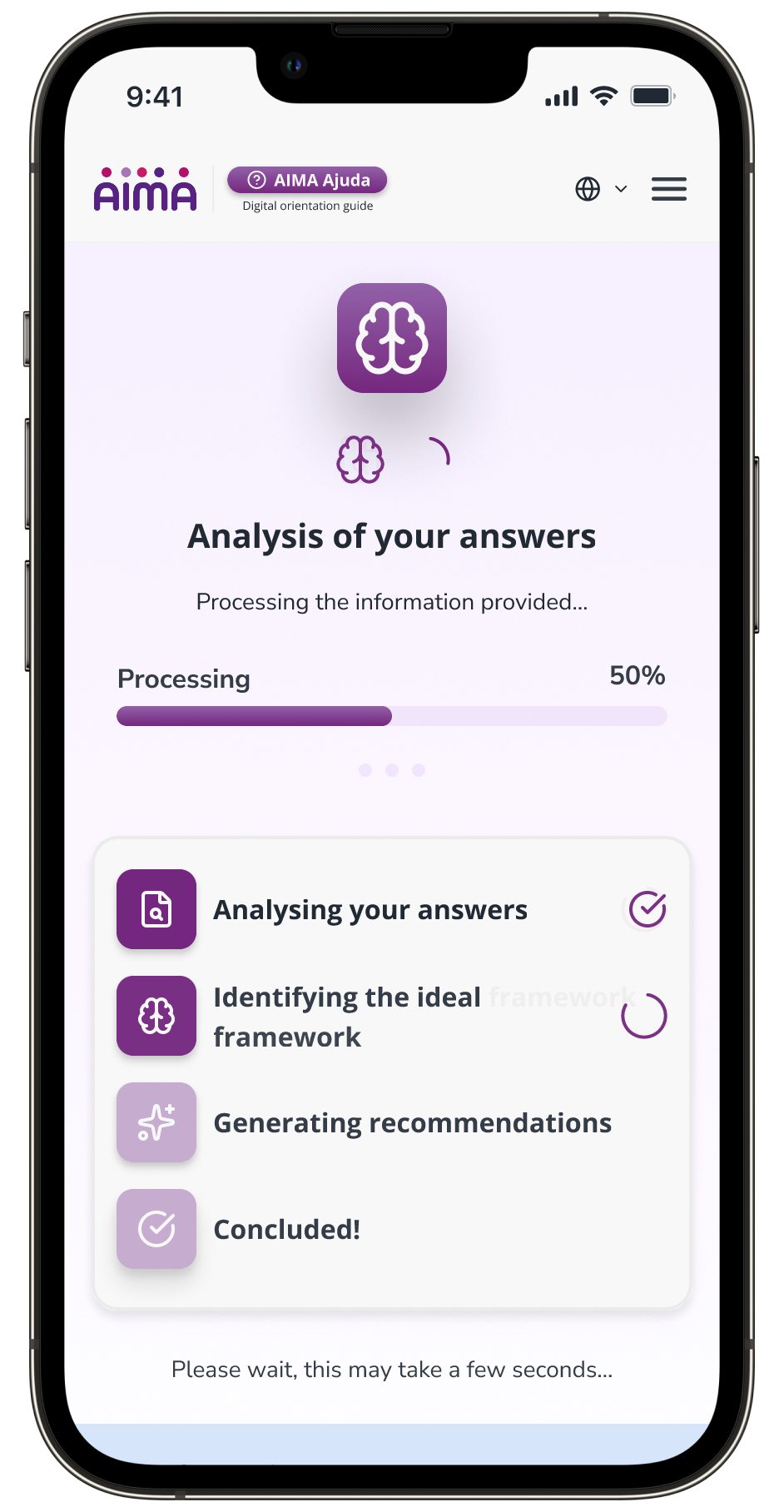
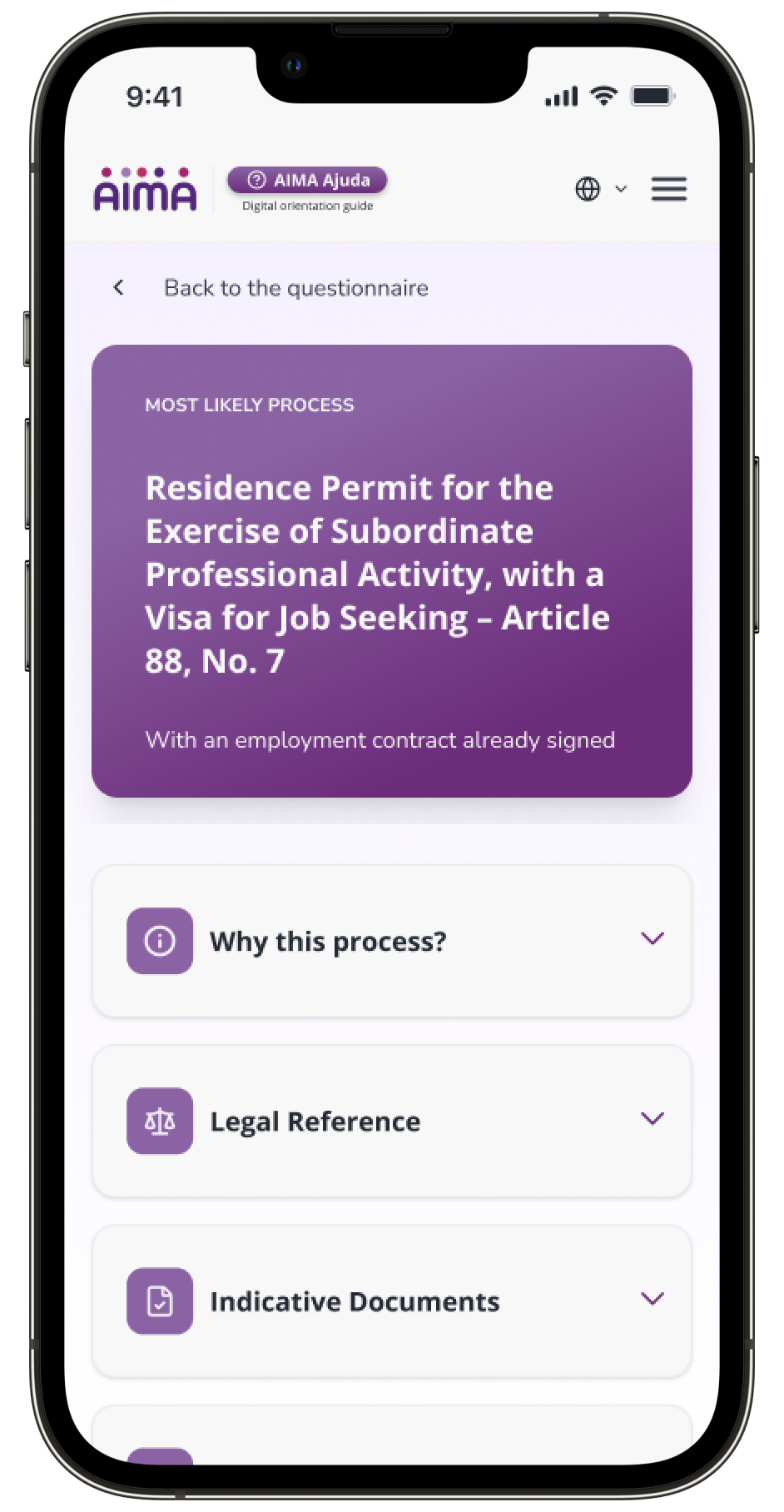
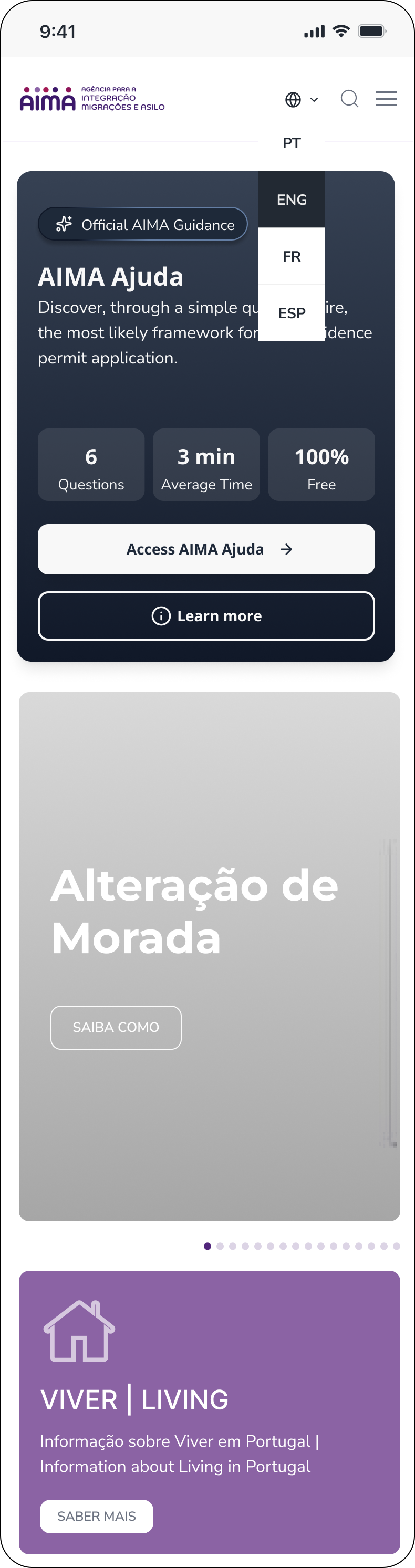
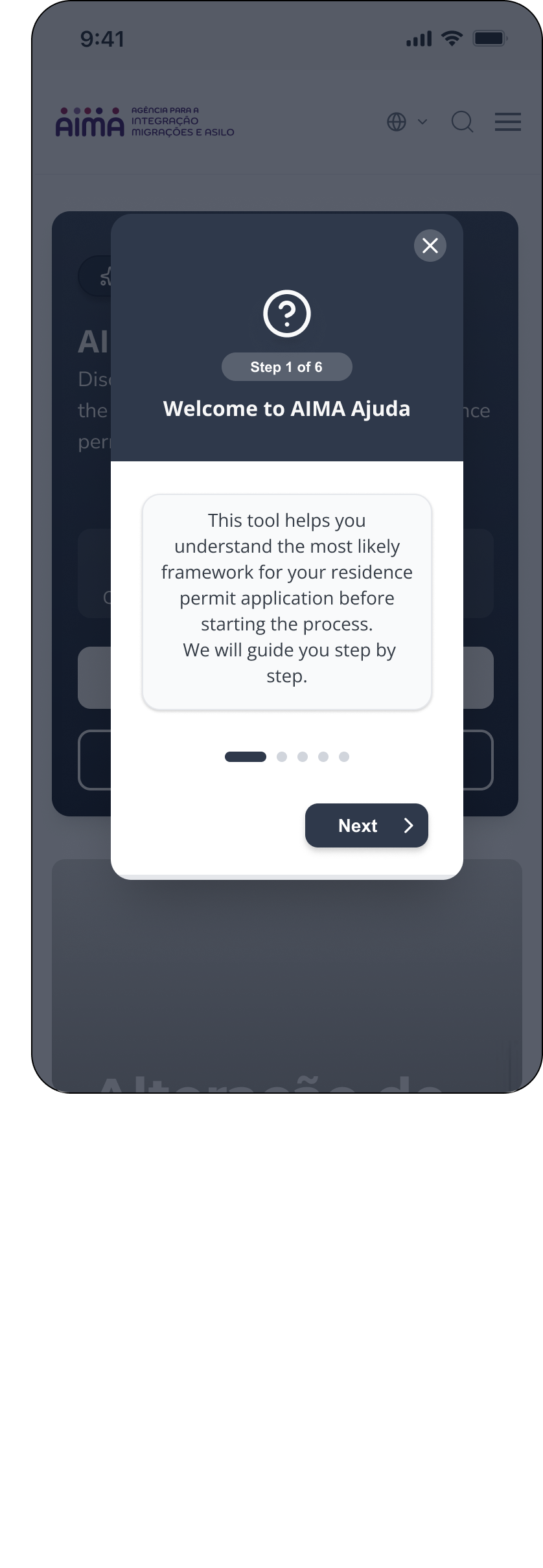
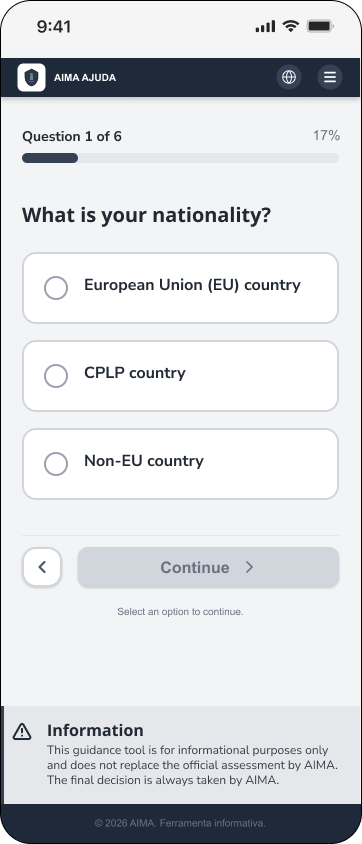
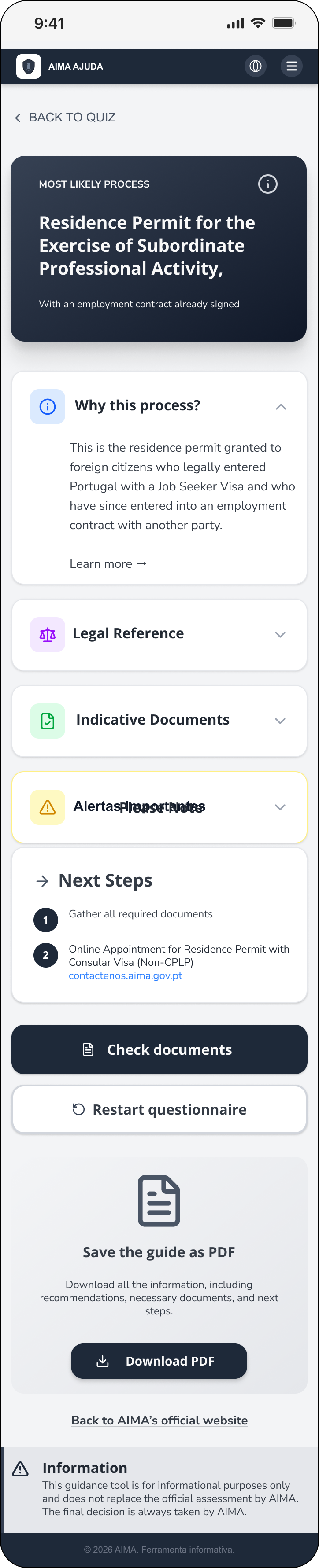
Lo-fi and mid-fi wireframes translated the agreed flow into a complete orientation journey: from the AIMA entry point, through a structured six-question quiz, to guided results and an optional document check.
The flow was designed as a sequence of clear, predictable moments. Each stage makes clear what the user is being asked to do, what happens next, and, where relevant, what remains subject to AIMA’s final validation.
01. Entry point & introductory wizard
02. Six-question
orientation quiz
03. AI-assisted
interpretation
04. Guided result
05. Optional AI-assisted
document check

USABILITY TESTING
Testing the moments where trust could break
The prototype was tested with four participants who had direct experience with AIMA processes and had never seen the solution before.
Participants moved through the journey without signs of disorientation. One participant noted that the tool “would save a lot of time searching on the AIMA’s website.”
The most useful findings were not about whether users could complete the flow. They revealed the moments where clarity and trust could weaken: the entry point, mobile readability, document capture, and the pacing of document analysis feedback.
4 participants
Direct AIMA experience
First-time prototype users
01. Clearer entry scope
The original entry banner was too broad and did not clearly communicate that AIMA Ajuda was an orientation tool, not a formal application process.
The copy was rewritten to set clearer expectations before users entered the flow.
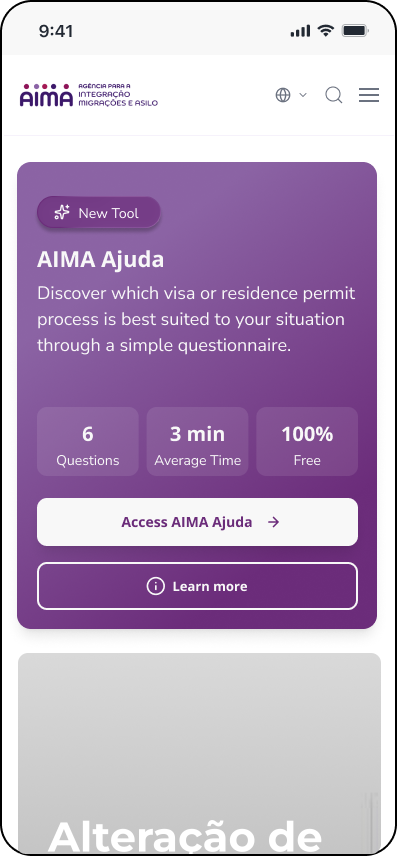
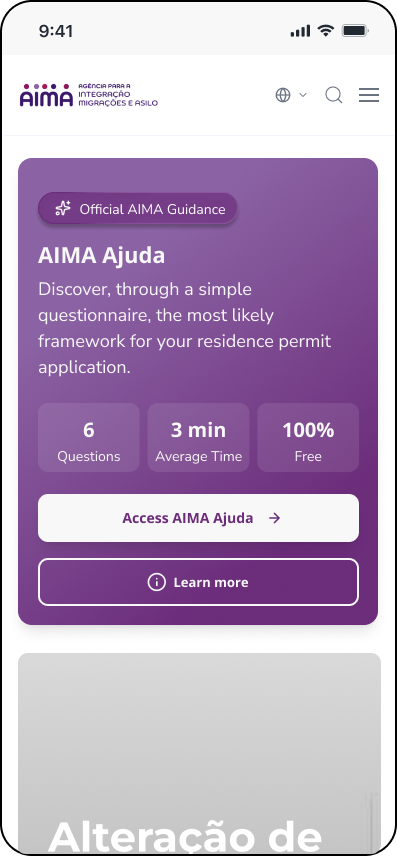
Clearer scope
Too broad
Before
After


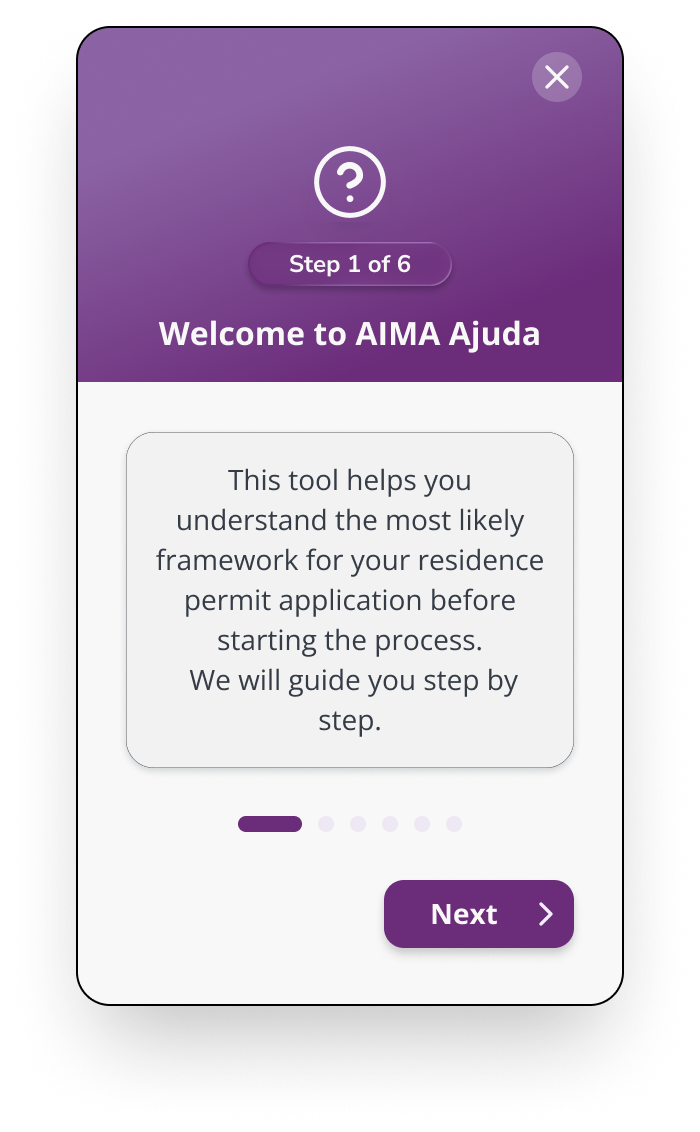
02. Mobile readability
Key screens in the wizard and document guidance flow were harder to read on smaller devices.
Typography was scaled up to better support users who rely on mobile access throughout the process.
Improved legibility
Smaller type
Before
After
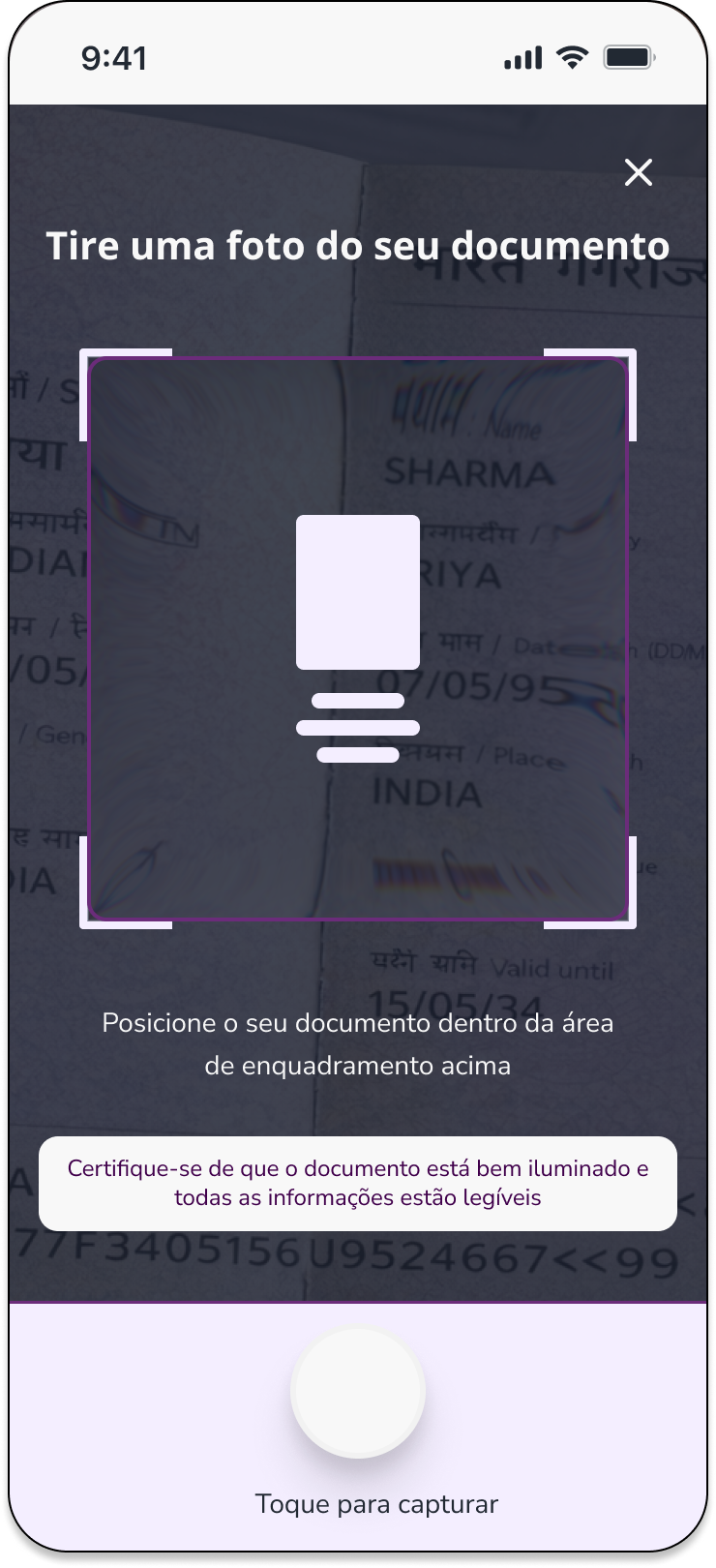
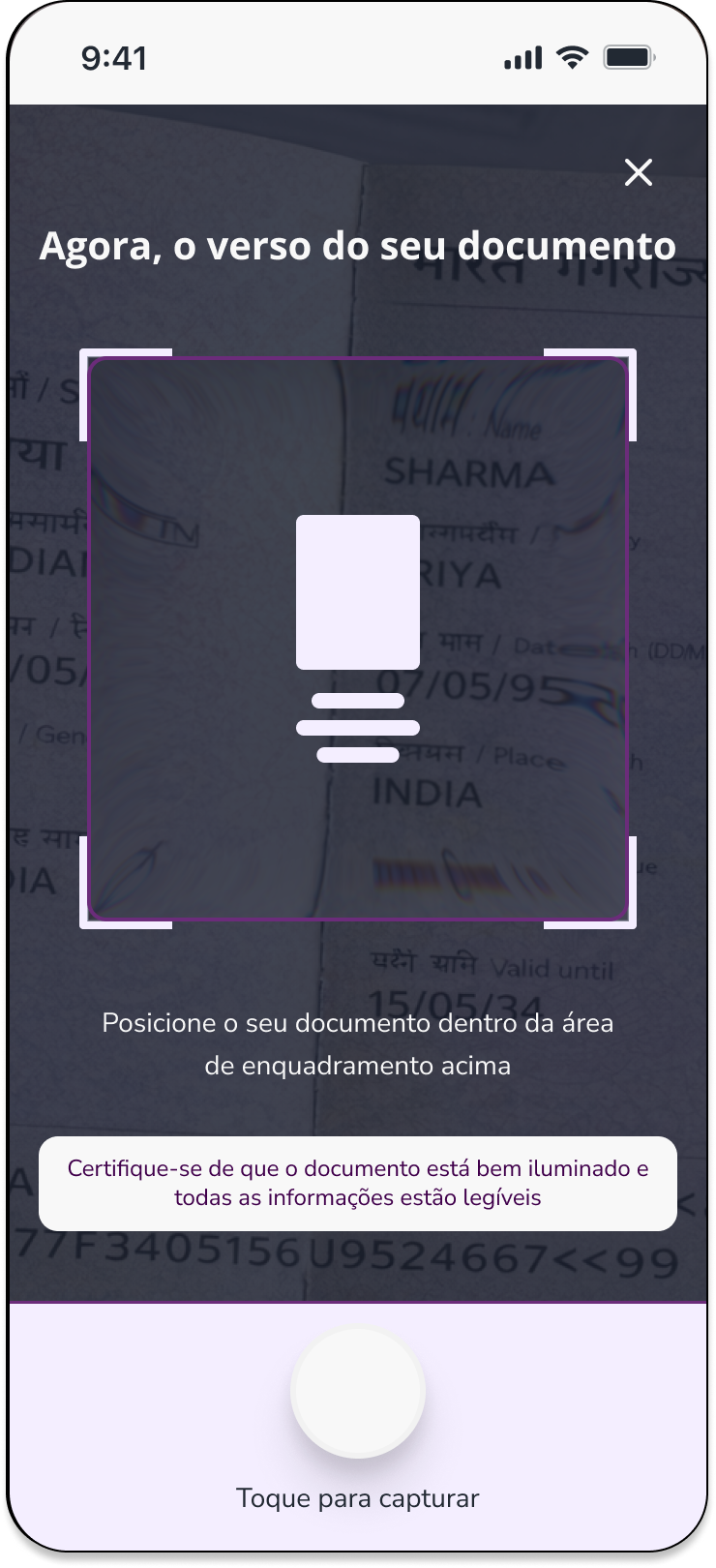
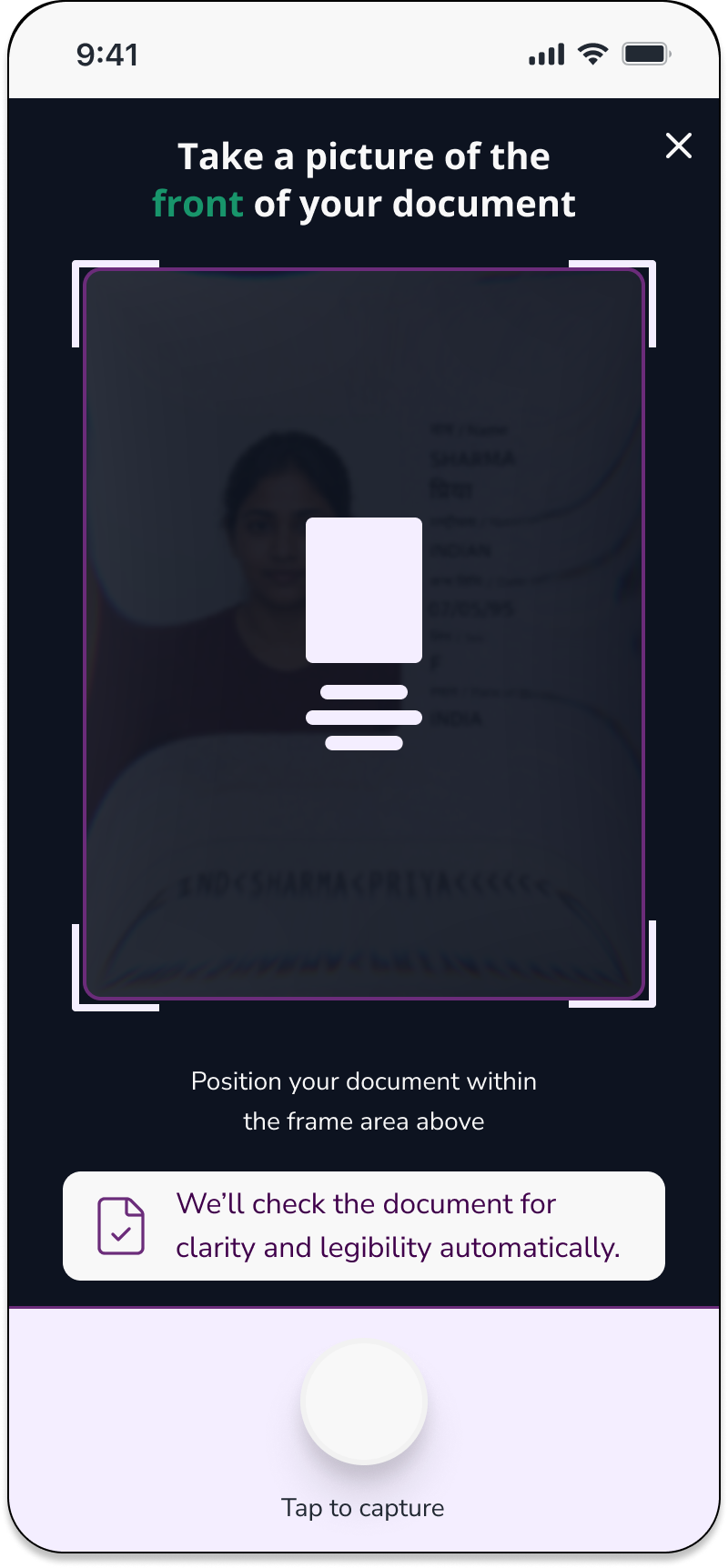
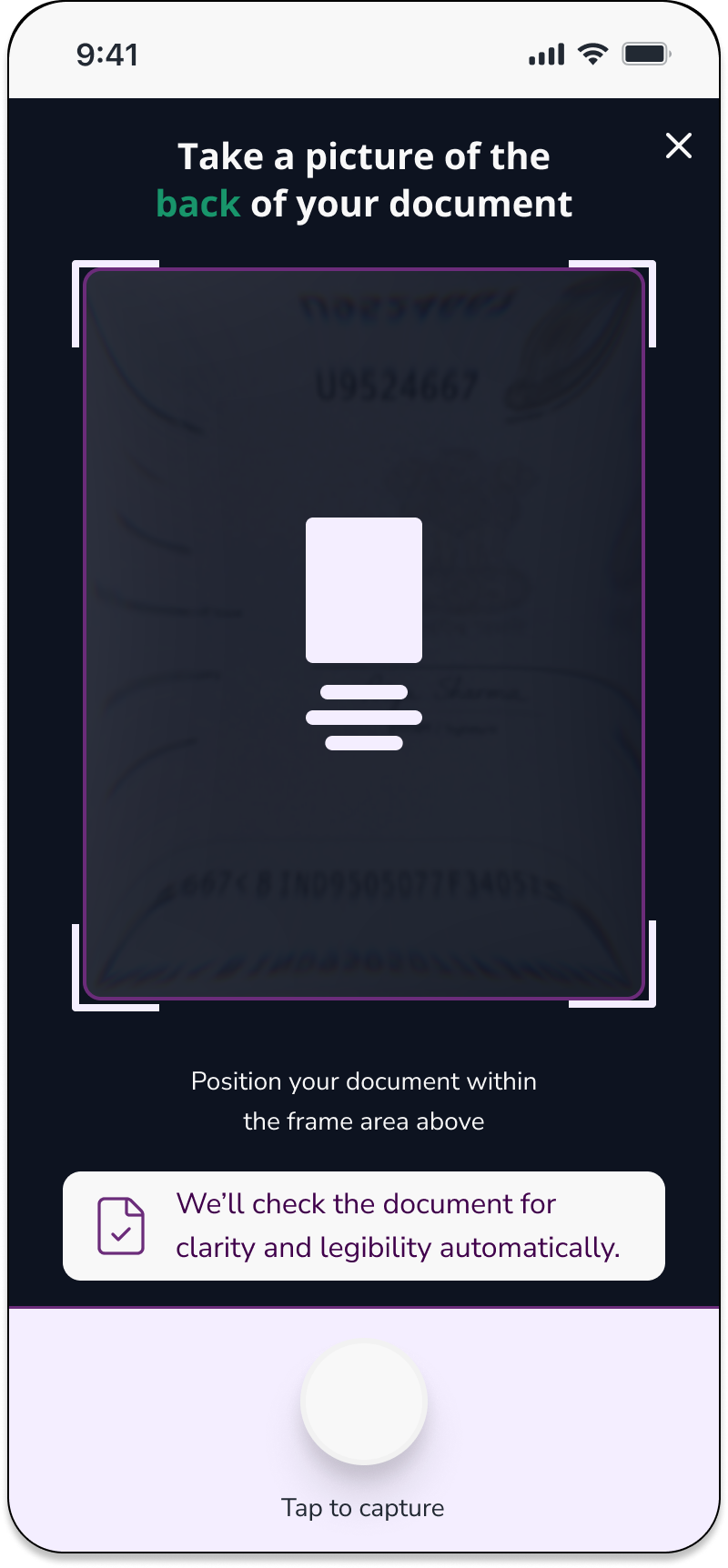
03. Clearer document capture
Users needed more explicit guidance when moving between the front and back of a document.
Step-specific microcopy made the capture sequence clearer and reduced uncertainty at a high-anxiety moment.
Ambiguous sequence
Step-by-step guidance
Before
After
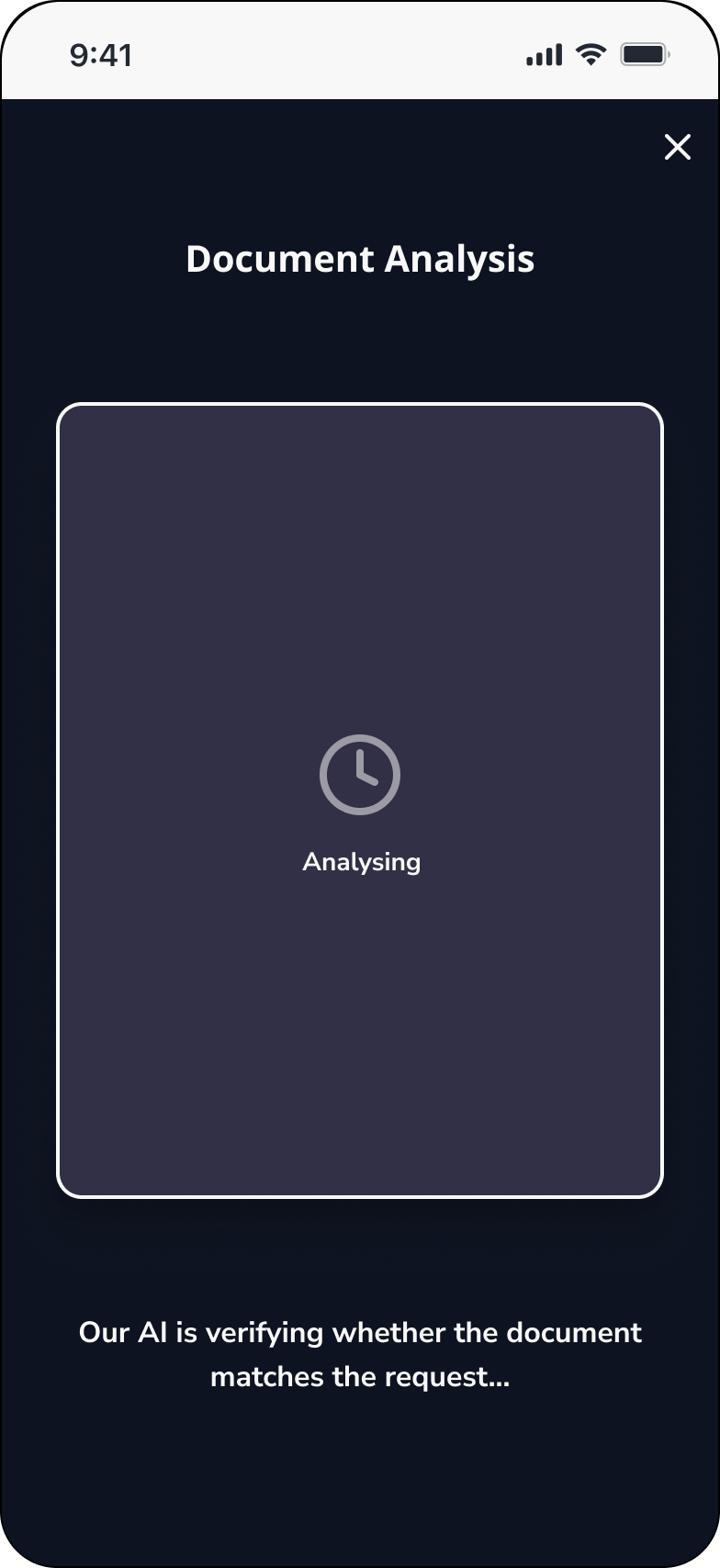
04. More credible analysis feedback
The transition from document analysis to the preparation result felt too immediate.
A longer processing state and smoother transition made the feedback feel more considered and credible.
Considered feedback
Immediate result
Before
After
The testing did not change the core flow. It refined the moments where uncertainty could turn into hesitation.
DESIGN SYSTEM
Designing trust into the interface
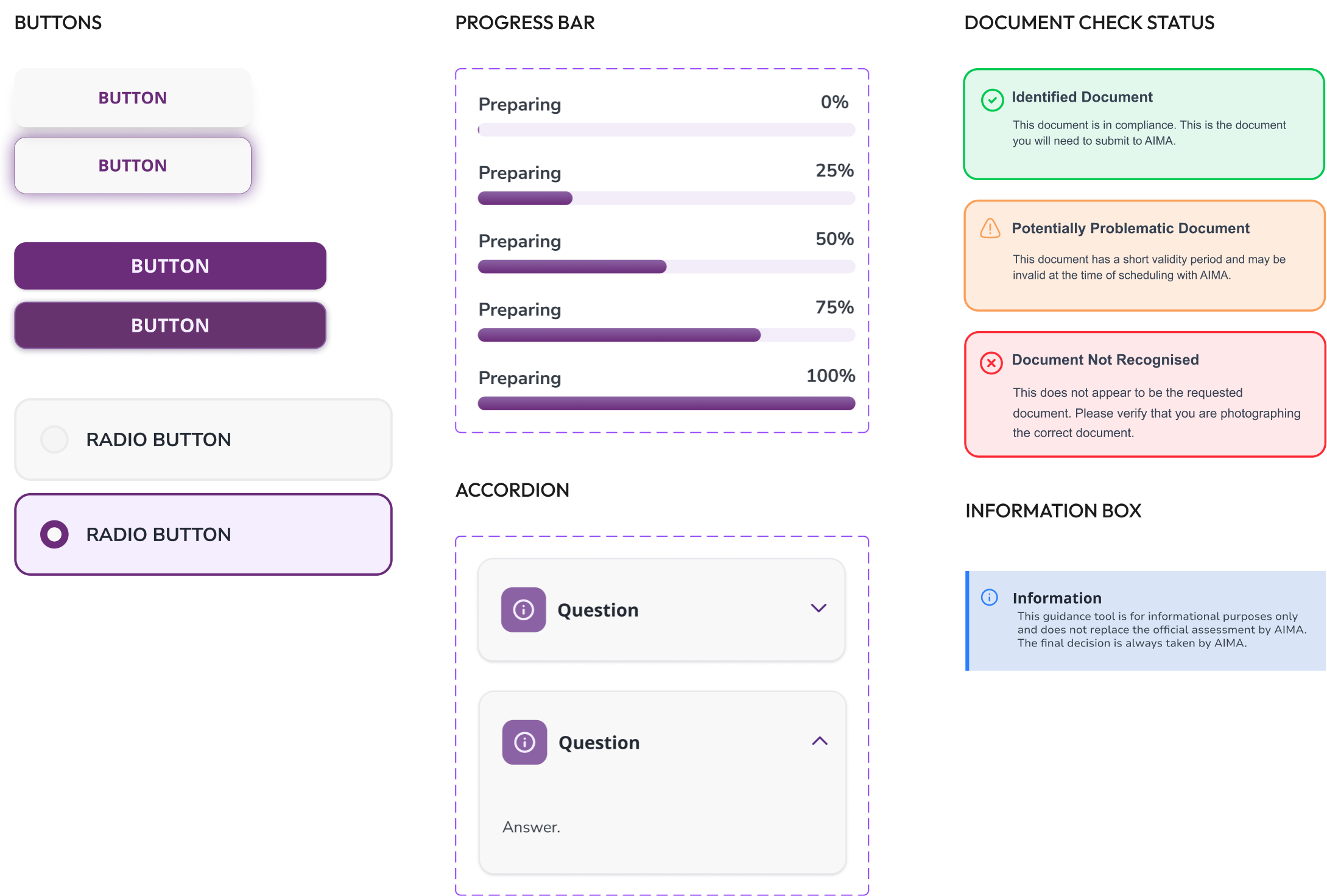
The visual identity was kept deliberately close to AIMA’s institutional aesthetic. This was a trust decision: AIMA Ajuda needed to feel like an extension of the official service, not a separate third-party tool.
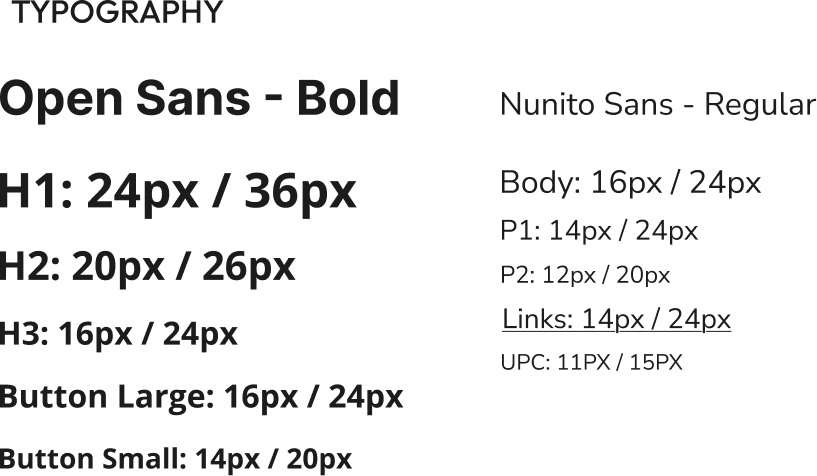
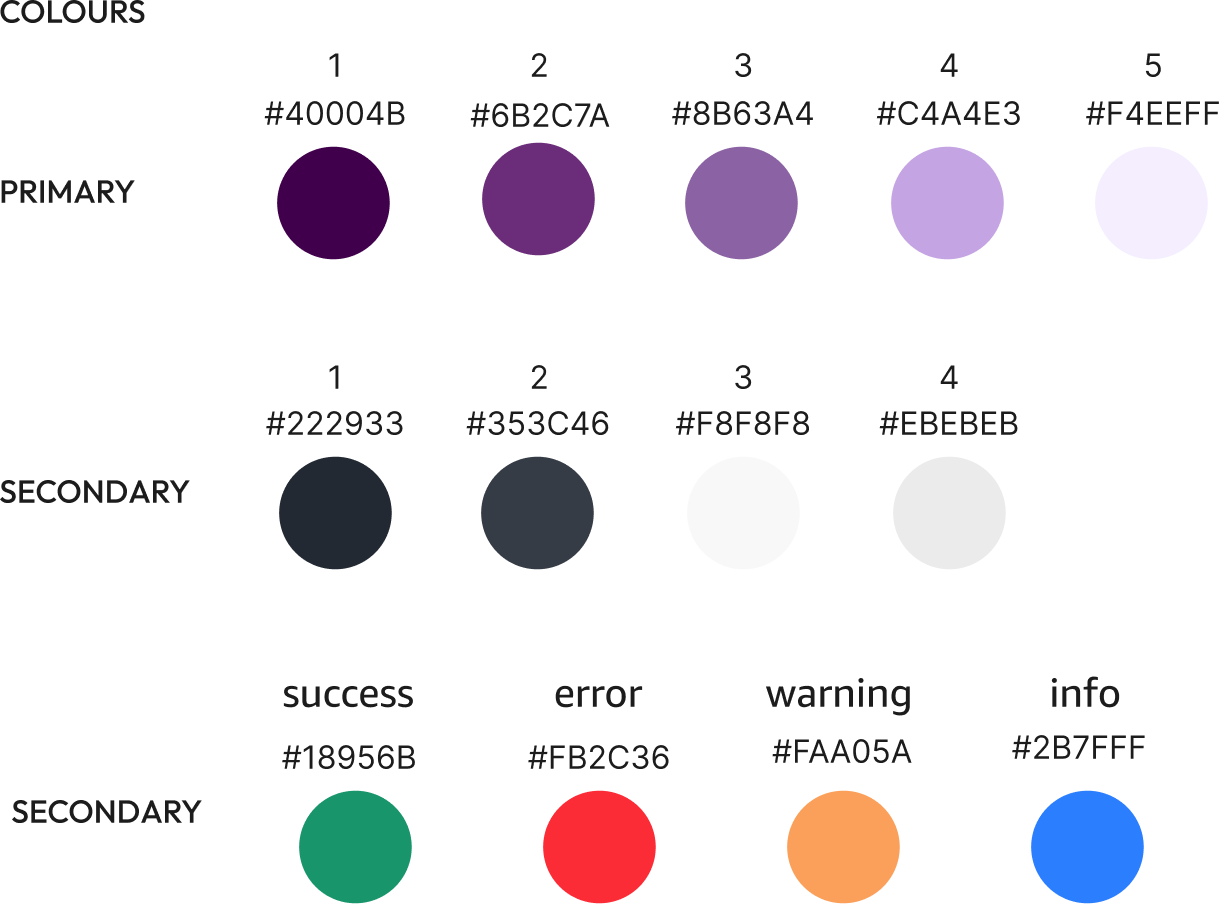
The design system included the AIMA Ajuda logo, colour palette, typography, icons, components, interactive states, and optional document check feedback patterns.

LOGO

Familiar enough to trust.
Clear enough to prepare.
FINAL EXPERIENCE
The final experience
The final prototype brings together the complete orientation journey: entry point, onboarding, language selection, structured quiz, guided results, downloadable guide, and an optional AI-assisted document check.
Each moment was designed to reduce uncertainty before the user takes formal action.

Want to explore the experience yourself?
EXPLORE THE INTERACTIVE PROTOTYPE ↗
Opens in Figma
EXPECTED IMPACT
Reducing avoidable friction before it becomes workload
AIMA Ajuda does not solve the wider immigration system. It focuses on the moment before formal action, where unclear guidance can turn into repeated questions, incomplete preparation, document issues, and avoidable rework.
Its intended value is both experiential and operational: clearer orientation for users, and more productive formal interactions for AIMA.
For AIMA
For users

Fewer repeated clarification requests, fewer avoidable preparation issues, and more productive formal interactions.
Clearer orientation, reduced uncertainty, and better preparation before engaging with AIMA.
FROM RESEARCH SIGNALS TO INTENDED IMPACT
Pressure point
Intended contribution
Research signal

Communication gaps
Clearer routes and fewer repeated clarification requests.
45%
Residence card delivery delays
Better-prepared users before submission
30%
Avoidable preparation errors
Clearer indicative documents and next steps
15%
* Projected outcomes based on research signals. Not measured results.
LIMITATIONS AND FUTURE EVOLUTION
What this project does not yet prove
AIMA Ajuda was designed as a first version of an orientation layer, not a finished public service. The prototype demonstrates how clearer guidance could reduce uncertainty before formal action, but it does not yet prove long-term impact, universal access, or operational readiness at scale.
01
Evidence before impact
Because the project was completed over four weeks, the research needed a focused and carefully scoped approach: ten survey responses, one focus group with three participants, and usability testing with four participants.
This was enough to identify recurring patterns, test the core journey, and refine the moments where trust could weaken. It was not enough to establish whether the service would reduce repeated clarification requests, avoidable preparation issues, or residence card delivery delays linked to incomplete files, incorrect documentation, or additional validations at scale.
The next step would be to test the service with real users and AIMA teams before scaling it, establishing a baseline and assessing whether clearer orientation leads to better-prepared formal interactions, fewer preparation-related errors, and greater confidence before action.
02
Access and continuity
The concept assumes access to a smartphone, reliable internet, and enough digital and language confidence to navigate a self-service flow. Those assumptions exclude some of the people who may need guidance most.
The next step would be to extend the service beyond a single self-service route: offering multilingual content, accessible formats, and clear in-person support for people who cannot rely on digital access alone. It should also create continuity between orientation and formal action, allowing guided results to connect directly to the relevant AIMA service and enabling returning users to save preparation notes, track document readiness, and receive updates as requirements or processes change.
03
Governance before scale
Immigration guidance cannot remain static. Legal rules, administrative requirements, and document expectations change over time. Without clear ownership, regular legal review, and transparent updates, a live service could quickly become unreliable.
The next step would be to establish a governance model for the service: defining who maintains legal content, who validates updates, and how changes are communicated to users. Any future AI capability should sit within that model, with explicit consent, strong privacy safeguards, and clear limits. It can support understanding and preparation, but should never validate legal eligibility, guarantee acceptance, make legal decisions, or replace AIMA’s final authority.

AIMA Ajuda
Helping immigrants understand where they stand before they enter the system.
A guided orientation tool integrated into AIMA’s official website, helping immigrants understand their likely legal framework, indicative documents, and next steps before any formal application begins.
Role
UX Research, Interaction Design, UI Design
Team
Margarida Marçal, Inês E., Ana C., Catarina N.
Timeline
Feb - Mar 2026
Tools
Figma, Miro, Adobe Illustrator
Type
Academic project, EDIT. Disruptive Digital School
CONTEXT
AIMA, in brief
AIMA is Portugal’s immigration authority, responsible for residency authorisations, visa renewals, asylum, and integration support. Since 2023, it has worked as a single point of contact for some of the most complex administrative processes a person can face: legal residency.
A system built around legal categories, not user situations
AIMA’s digital experience organises information around legal articles, not user situations. Users are expected to know which process applies to them before the system has helped them understand where they stand.This gap became the starting point for AIMA Ajuda.
Evidence from the places users were already asking for help
To understand where users were getting stuck, we combined public complaint data, community analysis, direct user research, and UX benchmarking.
Because immigrants in active legal processes can be difficult to recruit through conventional methods, we looked at the places where uncertainty was already visible: Reddit threads, Facebook groups, immigrant forums, survey responses, and one exploratory focus group. We also reviewed the official AIMA website through a heuristic benchmark and compared it with international immigration platforms.
RESEARCH FOUNDATION
Evidence sources:
Public complaint data helped quantify the pressure on the system. The qualitative research helped explain what was happening before users reached those failure points.
Portal da Queixa analysis, accessed March 2026.
Portal da Queixa data
International benchmark
Survey (N=10)
Focus group (3 participants)
AIMA heuristic benchmark
Community analysis
45%
communication failures
or no response
15%
document
submission errors
30%
delays in residence
card delivery
18%
overall
satisfaction rate
The numbers pointed to a system under pressure, but the research showed that many problems started earlier. Users were already lost before knowing which legal process applied to them, which documents mattered, or where to begin.
INSIGHTS
Five patterns shaped the solution
The research showed that users were not struggling because information was missing. They were struggling because the system expected them to understand which information applied to them before helping them make sense of their situation.
INSIGHT 1
The problem started before AIMA
Users were still trying to understand their own situation when the system already expected them to know which process applied to them.
INSIGHT 2
Information existed, but did not orient
Users could find content, but struggled to identify the right legal article, portal, documents, and order of steps.
INSIGHT 3
Legal language made mistakes feel risky
A misunderstood requirement could delay a residency process by months, affecting work, family stability, and legal status.
INSIGHT 4
Users relied on informal guidance
WhatsApp groups, Facebook communities, Reddit threads, TikTok videos, and informal advice became primary sources of orientation.
INSIGHT 5
Users wanted clarity, not automation
They did not want the system to decide for them. They wanted to understand which framework may apply, what documents matter, and what to expect next.
SYNTHESIS
Confusion had become part of the experience
The AIMA heuristic benchmark gave the research findings a structural frame. Cognitive load and deadline predictability were the two weakest criteria, both scoring 1 out of 5. The issue was not only that users felt confused. The interface repeatedly shifted responsibility onto them through ambiguous calls to action, dense legal text, hidden next steps, inconsistent interfaces, and weak feedback after key actions.
The opportunity was not to redesign the institution, simplify the law, or automate decisions. It was to add the missing layer between information and action.
A guided entry point.
USERS
Two very different users, one shared uncertainty
The research did not point to a single user archetype. It revealed two, and the distance between them matters.
Priya and Lucas sit at opposite ends of the spectrum: different languages, different levels of digital confidence, different devices, and different risk profiles. But neither of them could look at the AIMA platform and say with certainty: this is my process, and this is what I need to do.
What they reveal
One user struggles to access the system. The other struggles to trust its logic. But both reach the same point of uncertainty: the platform expects them to understand the process before it has helped them understand where they stand.
That became the design challenge: creating a guided starting point that could support both users without flattening their differences.
DESIGN CHALLENGE
AIMA’s digital experience was built for people who already know what they need. Our users don't yet.
PROBLEM STATEMENT
How might we help immigrants understand their legal standing in Portugal before they are asked to navigate a system that assumes they already know what they need?
GUIDING QUESTION
SOLUTION OVERVIEW
A guided entry point before formal action
AIMA Ajuda is a guided orientation tool designed to sit inside the official AIMA website, before any formal application begins.
Instead of asking users to read legislation and identify the right process on their own, it leads them through a short, structured orientation flow and returns a guided result they can use to prepare for their next interaction with AIMA.
STRUCTURED GUIDANCE AND AI USE
Where AI enters, and where it stops
The most important design decision in AIMA Ajuda was not visual. It was structural.
To build trust in a high-stakes public service, we separated structured guidance from AI use. The quiz works as a fixed, predictable flow, built around questions informed by relevant legislation and administrative requirements. It collects structured input, but it does not interpret, infer, or decide.
AI only enters after the quiz is complete. At that point, it helps translate the completed answer set into plain-language guidance, including a likely legal framework, why it may apply, the relevant legal reference, indicative documents, important notes, and next steps.
A second AI layer is available only if the user chooses to continue to the optional document check. Because this involves personal documents, it is optional and requires explicit acceptance of terms and conditions before any upload or analysis begins.
The system can check whether an uploaded document appears to match the expected type, whether key fields are present, whether the image is legible, and whether anything important seems to be missing. The result is returned as a preparation status: apparently adequate, potentially problematic, or clearly incorrect.
In every case, the interface reinforces that final validation remains exclusively with AIMA.

01
Structured Quiz
No AI


Structured questionsA decision-tree flow built from service logic and legal requirements.

Clear, fixed flowAnswers are collected through clear, fixed options, with no AI involvement.

02
AI-assisted interpretation


Plain-language guidanceThe completed answer set is translated into clear, understandable guidance.

Likely legal frameworkThe result presents the legal framework most likely to apply, with context on why it may fit the user’s situation.

Legal referenceRelevant legal references are surfaced so users can understand the basis of the result.

Indicative documentsDocuments typically associated with that framework are presented as guidance.

Notes and next stepsKey conditions, fees, and next steps are explained.
03
Optional AI-assisted
document check
Optional

Consent before uploadTerms and conditions are accepted before any document analysis begins.

AI-assisted checksAI reviews document type, legibility, key fields, and missing elements.

Three possible outcomesApparently adequate, potentially problematic, or clearly incorrect.

AIMA remains the authorityThe system supports preparation, but final validation remains exclusively with AIMA.
AI is used twice, but never as a legal decision-maker.
DESIGN PROCESS
From paper to product
The process started on paper. Three members of the team independently sketched different approaches to the main flow, exploring how the experience could guide users from uncertainty to preparation.
The full team then reviewed those early ideas together. Rather than selecting a single proposal, we carried forward the strongest parts of each: a clearer introduction before users were asked to act, a distinct orientation layer within the AIMA website, and a structured quiz-led flow with guided results and optional document check.
The process was not linear. Every iteration came back to the same question: what is the most critical moment for the user, and what is the simplest way to support it?
01 PAPER EXPLORATION
Three initial sketches explored different ways of guiding users through the main flow.
02 WHAT CARRIED FORWARD
The final flow was shaped by translating the strongest ideas from each early proposal into clearer moments of guidance.
What the sketches revealed
What it became

A clear starting point
Introductory wizard

A clear starting point
Introductory wizard

A distinct orientation layer
AIMA Ajuda before formal action
A predictable progression
Quiz → guided results → optional document check
A predictable progression
Quiz → guided results → optional document check
Guided orientation before formal action
03 DIGITAL STRUCTURE
Representative screens from the mid-fi flow.
Lo-fi and mid-fi wireframes translated the agreed flow into a complete orientation journey: from the AIMA entry point, through a structured six-question quiz, to guided results and an optional document check.
The flow was designed as a sequence of clear, predictable moments. Each stage makes clear what the user is being asked to do, what happens next, and, where relevant, what remains subject to AIMA’s final validation.
01. Entry point & introductory wizard
02. Six-question orientation quiz
03. AI-assisted interpretation
04. Guided result
05. Optional AI-assisted document check
USABILITY TESTING
Testing the moments where trust could break
The prototype was tested with four participants who had direct experience with AIMA processes and had never seen the solution before.
Participants moved through the journey without signs of disorientation. One participant noted that the tool “would save a lot of time searching on the AIMA’s website.”
The most useful findings were not about whether users could complete the flow. They revealed the moments where clarity and trust could weaken: the entry point, mobile readability, document capture, and the pacing of document analysis feedback.
4 participants
Direct AIMA experience
First-time prototype users
01. Clearer entry scope
The original entry banner was too broad and did not clearly communicate that AIMA Ajuda was an orientation tool, not a formal application process.
The copy was rewritten to set clearer expectations before users entered the flow.
Clearer scope
Too broad
Before
After

02. Mobile readability
Key screens in the wizard and document guidance flow were harder to read on smaller devices.
Typography was scaled up to better support users who rely on mobile access throughout the process.
Improved legibility
Smaller type
Before
After
03. Clearer document capture
Users needed more explicit guidance when moving between the front and back of a document.
Step-specific microcopy made the capture sequence clearer and reduced uncertainty at a high-anxiety moment.
Ambiguous sequence
Step-by-step guidance
Before
After
04. More credible analysis feedback
The transition from document analysis to the preparation result felt too immediate.
A longer processing state and smoother transition made the feedback feel more considered and credible.
Considered feedback
Immediate result
Before
After
The testing did not change the core flow. It refined the moments where uncertainty could turn into hesitation.
DESIGN SYSTEM
Designing trust into the interface
The visual identity was kept deliberately close to AIMA’s institutional aesthetic. This was a trust decision: AIMA Ajuda needed to feel like an extension of the official service, not a separate third-party tool.
The design system included the AIMA Ajuda logo, colour palette, typography, icons, components, interactive states, and optional document check feedback patterns.

LOGO

Familiar enough to trust. Clear enough to prepare.
FINAL EXPERIENCE
The final experience
The final prototype brings together the complete orientation journey: entry point, onboarding, language selection, structured quiz, guided results, downloadable guide, and an optional AI-assisted document check.
Each moment was designed to reduce uncertainty before the user takes formal action.
Want to explore the experience yourself?
EXPLORE THE INTERACTIVE PROTOTYPE ↗
Opens in Figma
EXPECTED IMPACT
Reducing avoidable friction before it becomes workload
AIMA Ajuda does not solve the wider immigration system. It focuses on the moment before formal action, where unclear guidance can turn into repeated questions, incomplete preparation, document issues, and avoidable rework.
Its intended value is both experiential and operational: clearer orientation for users, and more productive formal interactions for AIMA.
For AIMA
For users

Fewer repeated clarification requests, fewer avoidable preparation issues, and more productive formal interactions.
Clearer orientation, reduced uncertainty, and better preparation before engaging with AIMA.
FROM RESEARCH SIGNALS TO INTENDED IMPACT
Pressure point
Intended contribution
Research signal
Communication gaps
Clearer routes and fewer repeated clarification requests.
45%
Residence card delivery delays
Better-prepared users before submission
30%
Avoidable preparation errors
Clearer indicative documents and next steps
15%
* Projected outcomes based on research signals. Not measured results.
LIMITATIONS AND FUTURE EVOLUTION
What this project does not yet prove
AIMA Ajuda was designed as a first version of an orientation layer, not a finished public service. The prototype demonstrates how clearer guidance could reduce uncertainty before formal action, but it does not yet prove long-term impact, universal access, or operational readiness at scale.
01
Evidence before impact
Because the project was completed over four weeks, the research needed a focused and carefully scoped approach: ten survey responses, one focus group with three participants, and usability testing with four participants.
This was enough to identify recurring patterns, test the core journey, and refine the moments where trust could weaken. It was not enough to establish whether the service would reduce repeated clarification requests, avoidable preparation issues, or residence card delivery delays linked to incomplete files, incorrect documentation, or additional validations at scale.
The next step would be to test the service with real users and AIMA teams before scaling it, establishing a baseline and assessing whether clearer orientation leads to better-prepared formal interactions, fewer preparation-related errors, and greater confidence before action.
02
Access and continuity
The concept assumes access to a smartphone, reliable internet, and enough digital and language confidence to navigate a self-service flow. Those assumptions exclude some of the people who may need guidance most.
The next step would be to extend the service beyond a single self-service route: offering multilingual content, accessible formats, and clear in-person support for people who cannot rely on digital access alone. It should also create continuity between orientation and formal action, allowing guided results to connect directly to the relevant AIMA service and enabling returning users to save preparation notes, track document readiness, and receive updates as requirements or processes change.
03
Governance before scale
Immigration guidance cannot remain static. Legal rules, administrative requirements, and document expectations change over time. Without clear ownership, regular legal review, and transparent updates, a live service could quickly become unreliable.
The next step would be to establish a governance model for the service: defining who maintains legal content, who validates updates, and how changes are communicated to users. Any future AI capability should sit within that model, with explicit consent, strong privacy safeguards, and clear limits. It can support understanding and preparation, but should never validate legal eligibility, guarantee acceptance, make legal decisions, or replace AIMA’s final authority.

AIMA Ajuda
Helping immigrants understand where they stand before they enter the system.
A guided orientation tool integrated into AIMA’s official website, helping immigrants understand their likely legal framework, indicative documents, and next steps before any formal application begins.
Role
UX Research, Interaction Design, UI Design
Team
Margarida Marçal, Inês E., Ana C., Catarina N.
Timeline
Feb - Mar 2026
Tools
Figma, Miro, Adobe Illustrator
Type
Academic project, EDIT. Disruptive Digital School
CONTEXT
AIMA, in brief
AIMA is Portugal’s immigration authority, responsible for residency authorisations, visa renewals, asylum, and integration support. Since 2023, it has worked as a single point of contact for some of the most complex administrative processes a person can face: legal residency.
A system built around legal categories, not user situations
AIMA’s digital experience organises information around legal articles, not user situations. Users are expected to know which process applies to them before the system has helped them understand where they stand.This gap became the starting point for AIMA Ajuda.
Evidence from the places users were already asking for help
To understand where users were getting stuck, we combined public complaint data, community analysis, direct user research, and UX benchmarking.
Because immigrants in active legal processes can be difficult to recruit through conventional methods, we looked at the places where uncertainty was already visible: Reddit threads, Facebook groups, immigrant forums, survey responses, and one exploratory focus group. We also reviewed the official AIMA website through a heuristic benchmark and compared it with international immigration platforms.
RESEARCH FOUNDATION
Public complaint data helped quantify the pressure on the system. The qualitative research helped explain what was happening before users reached those failure points.
Portal da Queixa analysis, accessed March 2026.
Portal da Queixa data
International benchmark
Survey (N=10)
Focus group (3 participants)
AIMA heuristic benchmark
Community analysis
Evidence sources:
45%
communication failures
or no response
15%
document
submission errors
30%
delays in residence
card delivery
18%
overall
satisfaction rate
The numbers pointed to a system under pressure, but the research showed that many problems started earlier. Users were already lost before knowing which legal process applied to them, which documents mattered, or where to begin.
INSIGHTS
Five patterns shaped the solution
The research showed that users were not struggling because information was missing. They were struggling because the system expected them to understand which information applied to them before helping them make sense of their situation.
INSIGHT 1
The problem started before AIMA
Users were still trying to understand their own situation when the system already expected them to know which process applied to them.
INSIGHT 2
Information existed, but did not orient
Users could find content, but struggled to identify the right legal article, portal, documents, and order of steps.
INSIGHT 3
Legal language made mistakes feel risky
A misunderstood requirement could delay a residency process by months, affecting work, family stability, and legal status.
INSIGHT 4
Users relied on informal guidance
WhatsApp groups, Facebook communities, Reddit threads, TikTok videos, and informal advice became primary sources of orientation.
INSIGHT 5
Users wanted clarity, not automation
They did not want the system to decide for them. They wanted to understand which framework may apply, what documents matter, and what to expect next.
SYNTHESIS
Confusion had become part of the experience
The AIMA heuristic benchmark gave the research findings a structural frame. Cognitive load and deadline predictability were the two weakest criteria, both scoring 1 out of 5. The issue was not only that users felt confused. The interface repeatedly shifted responsibility onto them through ambiguous calls to action, dense legal text, hidden next steps, inconsistent interfaces, and weak feedback after key actions.
The opportunity was not to redesign the institution, simplify the law, or automate decisions. It was to add the missing layer between information and action.
A guided entry point.
USERS
Two very different users, one shared uncertainty
The research did not point to a single user archetype. It revealed two, and the distance between them matters.
Priya and Lucas sit at opposite ends of the spectrum: different languages, different levels of digital confidence, different devices, and different risk profiles. But neither of them could look at the AIMA platform and say with certainty: this is my process, and this is what I need to do.
What they reveal
One user struggles to access the system. The other struggles to trust its logic. But both reach the same point of uncertainty: the platform expects them to understand the process before it has helped them understand where they stand.
That became the design challenge: creating a guided starting point that could support both users without flattening their differences.
DESIGN CHALLENGE
AIMA’s digital experience was built for people who already know what they need. Our users don't yet.
PROBLEM STATEMENT
How might we help immigrants understand their legal standing in Portugal before they are asked to navigate a system that assumes they already know what they need?
GUIDING QUESTION
SOLUTION OVERVIEW
A guided entry point before formal action
AIMA Ajuda is a guided orientation tool designed to sit inside the official AIMA website, before any formal application begins.
Instead of asking users to read legislation and identify the right process on their own, it leads them through a short, structured orientation flow and returns a guided result they can use to prepare for their next interaction with AIMA.
STRUCTURED GUIDANCE AND AI USE
Where AI enters, and where it stops
The most important design decision in AIMA Ajuda was not visual. It was structural.
To build trust in a high-stakes public service, we separated structured guidance from AI use. The quiz works as a fixed, predictable flow, built around questions informed by relevant legislation and administrative requirements. It collects structured input, but it does not interpret, infer, or decide.
AI only enters after the quiz is complete. At that point, it helps translate the completed answer set into plain-language guidance, including a likely legal framework, why it may apply, the relevant legal reference, indicative documents, important notes, and next steps.
A second AI layer is available only if the user chooses to continue to the optional document check. Because this involves personal documents, it is optional and requires explicit acceptance of terms and conditions before any upload or analysis begins.
The system can check whether an uploaded document appears to match the expected type, whether key fields are present, whether the image is legible, and whether anything important seems to be missing. The result is returned as a preparation status: apparently adequate, potentially problematic, or clearly incorrect.
In every case, the interface reinforces that final validation remains exclusively with AIMA.

01
Structured Quiz
No AI


Structured questionsA decision-tree flow built from service logic and legal requirements.

Clear, fixed flowAnswers are collected through clear, fixed options, with no AI involvement.
02
AI-assisted interpretation

Plain-language guidanceThe completed answer set is translated into clear, understandable guidance.

Likely legal frameworkThe result presents the legal framework most likely to apply, with context on why it may fit the user’s situation.

Legal referenceRelevant legal references are surfaced so users can understand the basis of the result.

Indicative documentsDocuments typically associated with that framework are presented as guidance.

Notes and next stepsKey conditions, fees, and next steps are explained.
03
Optional AI-assisted
document check
Optional

Consent before uploadTerms and conditions are accepted before any document analysis begins.

AI-assisted checksAI reviews document type, legibility, key fields, and missing elements.

Three possible outcomesApparently adequate, potentially problematic, or clearly incorrect.

AIMA remains the authorityThe system supports preparation, but final validation remains exclusively with AIMA.
AI is used twice, but never as a legal decision-maker.
DESIGN PROCESS
From paper to product
The process started on paper. Three members of the team independently sketched different approaches to the main flow, exploring how the experience could guide users from uncertainty to preparation.
The full team then reviewed those early ideas together. Rather than selecting a single proposal, we carried forward the strongest parts of each: a clearer introduction before users were asked to act, a distinct orientation layer within the AIMA website, and a structured quiz-led flow with guided results and optional document check.
The process was not linear. Every iteration came back to the same question: what is the most critical moment for the user, and what is the simplest way to support it?
01 PAPER EXPLORATION
Three initial sketches explored different ways of guiding users through the main flow.
02 WHAT CARRIED FORWARD
The final flow was shaped by translating the strongest ideas from each early proposal into clearer moments of guidance.
What the sketches revealed
What it became

A clear starting point
Introductory wizard
A distinct orientation layer
AIMA Ajuda before formal action

A predictable progression
Quiz → guided results → optional document check
Guided orientation before formal action
03 DIGITAL STRUCTURE
Representative screens from the mid-fi flow.
Lo-fi and mid-fi wireframes translated the agreed flow into a complete orientation journey: from the AIMA entry point, through a structured six-question quiz, to guided results and an optional document check.
The flow was designed as a sequence of clear, predictable moments. Each stage makes clear what the user is being asked to do, what happens next, and, where relevant, what remains subject to AIMA’s final validation.
01. Entry point & introductory wizard
02. Six-question orientation quiz
03. AI-assisted interpretation
04. Guided result
05. Optional AI-assisted document check
USABILITY TESTING
Testing the moments where trust could break
The prototype was tested with four participants who had direct experience with AIMA processes and had never seen the solution before.
Participants moved through the journey without signs of disorientation. One participant noted that the tool “would save a lot of time searching on the AIMA’s website.”
The most useful findings were not about whether users could complete the flow. They revealed the moments where clarity and trust could weaken: the entry point, mobile readability, document capture, and the pacing of document analysis feedback.
4 participants
Direct AIMA experience
First-time prototype users
01. Clearer entry scope
The original entry banner was too broad and did not clearly communicate that AIMA Ajuda was an orientation tool, not a formal application process.
The copy was rewritten to set clearer expectations before users entered the flow.
Clearer scope
Too broad
Before
After

02. Mobile readability
Key screens in the wizard and document guidance flow were harder to read on smaller devices.
Typography was scaled up to better support users who rely on mobile access throughout the process.
Improved legibility
Smaller type
Before
After
03. Clearer document capture
Users needed more explicit guidance when moving between the front and back of a document.
Step-specific microcopy made the capture sequence clearer and reduced uncertainty at a high-anxiety moment.
Ambiguous sequence
Step-by-step guidance
Before
After
04. More credible analysis feedback
The transition from document analysis to the preparation result felt too immediate.
A longer processing state and smoother transition made the feedback feel more considered and credible.
Considered feedback
Immediate result
Before
After
The testing did not change the core flow. It refined the moments where uncertainty could turn into hesitation.
DESIGN SYSTEM
Designing trust into the interface
The visual identity was kept deliberately close to AIMA’s institutional aesthetic. This was a trust decision: AIMA Ajuda needed to feel like an extension of the official service, not a separate third-party tool.
The design system included the AIMA Ajuda logo, colour palette, typography, icons, components, interactive states, and optional document check feedback patterns.

LOGO

Familiar enough to trust. Clear enough to prepare.
FINAL EXPERIENCE
The final experience
The final prototype brings together the complete orientation journey: entry point, onboarding, language selection, structured quiz, guided results, downloadable guide, and an optional AI-assisted document check.
Each moment was designed to reduce uncertainty before the user takes formal action.
Want to explore the experience yourself?
EXPLORE THE INTERACTIVE PROTOTYPE ↗
Opens in Figma
EXPECTED IMPACT
Reducing avoidable friction before it becomes workload
AIMA Ajuda does not solve the wider immigration system. It focuses on the moment before formal action, where unclear guidance can turn into repeated questions, incomplete preparation, document issues, and avoidable rework.
Its intended value is both experiential and operational: clearer orientation for users, and more productive formal interactions for AIMA.
For AIMA
For users

Fewer repeated clarification requests, fewer avoidable preparation issues, and more productive formal interactions.
Clearer orientation, reduced uncertainty, and better preparation before engaging with AIMA.
FROM RESEARCH SIGNALS TO INTENDED IMPACT
Pressure point
Intended contribution
Research signal
Communication gaps
Clearer routes and fewer repeated clarification requests.
45%
Residence card delivery delays
Better-prepared users before submission
30%
Avoidable preparation errors
Clearer indicative documents and next steps
15%
* Projected outcomes based on research signals. Not measured results.
LIMITATIONS AND FUTURE EVOLUTION
What this project does not yet prove
AIMA Ajuda was designed as a first version of an orientation layer, not a finished public service. The prototype demonstrates how clearer guidance could reduce uncertainty before formal action, but it does not yet prove long-term impact, universal access, or operational readiness at scale.
01
Evidence before impact
Because the project was completed over four weeks, the research needed a focused and carefully scoped approach: ten survey responses, one focus group with three participants, and usability testing with four participants.
This was enough to identify recurring patterns, test the core journey, and refine the moments where trust could weaken. It was not enough to establish whether the service would reduce repeated clarification requests, avoidable preparation issues, or residence card delivery delays linked to incomplete files, incorrect documentation, or additional validations at scale.
The next step would be to test the service with real users and AIMA teams before scaling it, establishing a baseline and assessing whether clearer orientation leads to better-prepared formal interactions, fewer preparation-related errors, and greater confidence before action.
02
Access and continuity
The concept assumes access to a smartphone, reliable internet, and enough digital and language confidence to navigate a self-service flow. Those assumptions exclude some of the people who may need guidance most.
The next step would be to extend the service beyond a single self-service route: offering multilingual content, accessible formats, and clear in-person support for people who cannot rely on digital access alone. It should also create continuity between orientation and formal action, allowing guided results to connect directly to the relevant AIMA service and enabling returning users to save preparation notes, track document readiness, and receive updates as requirements or processes change.
03
Governance before scale
Immigration guidance cannot remain static. Legal rules, administrative requirements, and document expectations change over time. Without clear ownership, regular legal review, and transparent updates, a live service could quickly become unreliable.
The next step would be to establish a governance model for the service: defining who maintains legal content, who validates updates, and how changes are communicated to users. Any future AI capability should sit within that model, with explicit consent, strong privacy safeguards, and clear limits. It can support understanding and preparation, but should never validate legal eligibility, guarantee acceptance, make legal decisions, or replace AIMA’s final authority.